Explained
Camp Towels, Explained
After reading, you'll know how to compare towels across sizes, which size to buy, and how to stop a microfiber towel smelling.
In this guide
Camp towels are sold on absorbency, expressed as a multiple of the towel's own weight. It is a genuinely relevant property and an unhelpful specification, because there is no common test behind it and the claims across brands vary by a factor of two. The numbers you can use are weight and unpacked size, because dividing one by the other gives a fabric mass per unit area that means the same thing whoever published it. After that the question is drying speed, then how small it packs.
The 30-second version
- Absorbency multiples are not standardised, so treat four times and twice as class indicators rather than as a ranking.
- Weight per area is the comparable number, and it varies roughly two to one across mainstream technical towels.
- Drying speed beats absorbency on a long trip, because a towel that stays damp makes everything near it damp too.
- Buy a size down, since a hand-towel size dries an adult and weighs a fraction of a body towel.
- Never use fabric softener, because it coats microfiber and is the usual reason a towel stops absorbing.
The products this guide is about
Our verdict on each, with the full reasoning on the companion review.
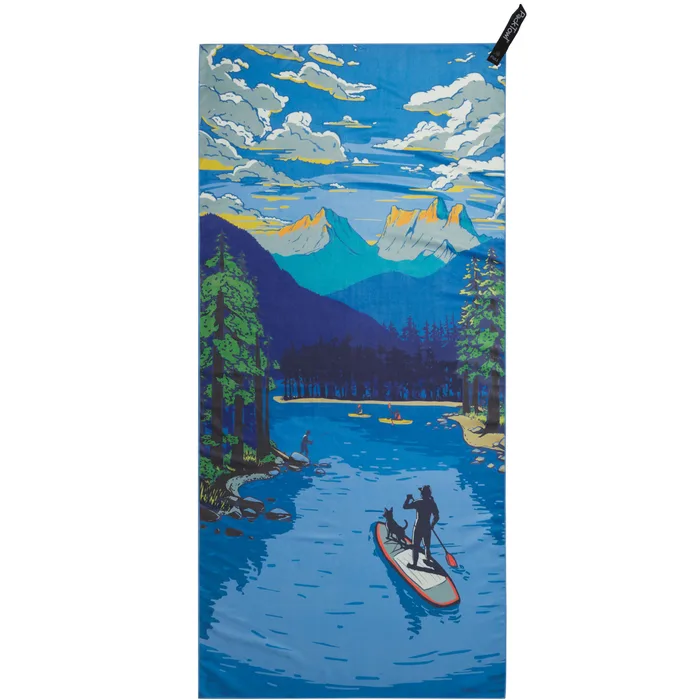
- Buy PackTowl Personal Towel The only towel here with a weight and a dimension published for every size, plus the two performance numbers the category is sold on.
- Buy Matador Ultralight Travel Towel, Large Full towel coverage at a stated 2.7 ounces, packing down to something you can close your hand around.
- It depends Sea to Summit Drylite Towel A named recycled fabric with a suede finish, positioned by its own maker as the lighter, more compact alternative to its bigger sibling.
- Skip Nomadix Original Towel A large, good-looking flat towel sold for travel, beach and yoga, which is a different job from drying yourself at a campsite.
What actually matters
- Absorbency multiple - how much water the towel holds relative to its own weight. Published by some makers, standardised by none, so useful as a rough class marker only.
- Weight and unpacked area - published together often enough to calculate fabric mass per unit area, which is the one figure that compares fairly across brands and sizes.
- Drying rate - how fast the towel gives the water back. More important than absorbency on multi-day trips, and rarely quantified.
- Packed size - the dimensions of the towel in its pouch. The specification that actually determines whether it joins your kit, and the one least often published.
- Fabric construction - microfiber pile, suede-finished microfiber, or flat woven. Pile absorbs more and holds grit; flat weaves shed sand and dry faster.
- Hanging hardware - a loop, press stud or carabiner buckle. Trivial-sounding and the difference between a towel that dries and one that does not.
- Storage pouch - a sealed pouch traps moisture, a mesh-faced one lets a damp towel keep drying while packed.
The specs, in plain English
Green flags vs red flags
Green flags
- A weight and a dimension published for every size offered.
- A packed size stated in figures.
- A drying claim with a number attached, even a comparative one.
- Fabric composition given as percentages rather than a trade name alone.
- A mesh-faced pouch or a hang loop, showing the maker expects the towel to be packed damp.
Red flags
- An absorbency multiple presented as the only performance information.
- No weight anywhere, on a product sold for travel.
- No size breakdown, so you cannot tell which option suits you.
- A sealed pouch with no ventilation.
- Marketing that lists beach and yoga ahead of camping, which tells you what it was designed for.
Who's who: the brands
- PackTowl - A Cascade Designs brand sold alongside MSR, and the most complete publisher of per-size weights, dimensions and performance claims in the category.
- Matador - Ultralight travel specialist, notable for publishing packed dimensions as well as weight, and for stating its towels are PFAS-free.
- Sea to Summit - Publishes exact fabric compositions and supplies mesh-faced pouches, with performance positioned against its own products rather than quantified.
- Nomadix - Flat woven, sand-shedding towels in large sizes and heavy on design, aimed at beach, travel and yoga rather than at packing small.
How to read a listing without getting fooled
Skip the absorbency headline and look for two numbers: a weight and an unpacked size. If both are there, divide one by the other and you have a figure you can compare against any other towel that publishes the same two, which is the only fair comparison in this category. Then look for a packed size, because that determines whether the towel makes your kit list, and treat its absence as a real gap on anything sold for travel. Check whether a drying claim exists at all, since it is the property that matters most past one night. Finally read the stated use case: a page that leads with beach and yoga is describing a different product from one that leads with camping, however similar the fabric sounds.
How much should you spend?
Budget technical towels are perfectly serviceable microfiber and are usually sold with no numbers at all, which is fine if you are buying by size and feel. The mid-range is where per-size weights, dimensions and published performance claims appear, and it is where most people should buy because it is where you can make an informed choice. Premium is buying a lower fabric mass per unit area and a published packed size, which is worth real money if you carry the towel and nothing at all if it lives in a car. Since a smaller size closes much of the weight gap for a fraction of the price, sizing down is usually a better value move than trading up.
Questions, answered
What size camp towel should I buy?
Smaller than you would use at home. A hand-towel size, roughly 16 by 36 inches, dries an adult perfectly well if you wring it once partway through, and weighs a fraction of a body towel. Body sizes are worth it if you dislike the wringing or are drying long hair. Face-cloth sizes are for exactly that, plus wiping down gear.
How do I dry a towel when it is raining?
Wring it hard, then hang it inside the tent rather than sealing it in a pouch. Wringing removes far more water than air drying will in a damp tent, and a towel that is merely damp rather than wet will not make the rest of your kit smell. If you have a mesh-faced pouch, pack it in that, because it keeps drying slowly instead of stopping.
Can I wash a microfiber towel normally?
Yes, warm wash with normal detergent, but never fabric softener. Softener works by coating fibres, which is precisely what destroys microfiber's ability to pick up water, and the damage is cumulative rather than instant. Tumble drying on low is fine for most, though air drying is kinder and quick given how fast these fabrics dry anyway.
Is a flat woven towel worse than a pile one?
Different rather than worse. Flat weaves shed sand, dry faster and pack flatter, which is why beach and yoga towels use them. Pile microfiber absorbs more water for its area, which is what you want when the towel is small and doing real work. For camp use, pile in a small size is usually the better trade.
Or jump to the head-to-head: PackTowl Personal Towel vs Matador Ultralight Travel Towel, Large.