

Outdoors & Fitness
The Best Camp Towels: 4 Compared (and One to Skip)
Two of these publish how much water they absorb as a multiple of their own weight. The two figures differ by a factor of two, and neither maker states how it was measured.
The short version
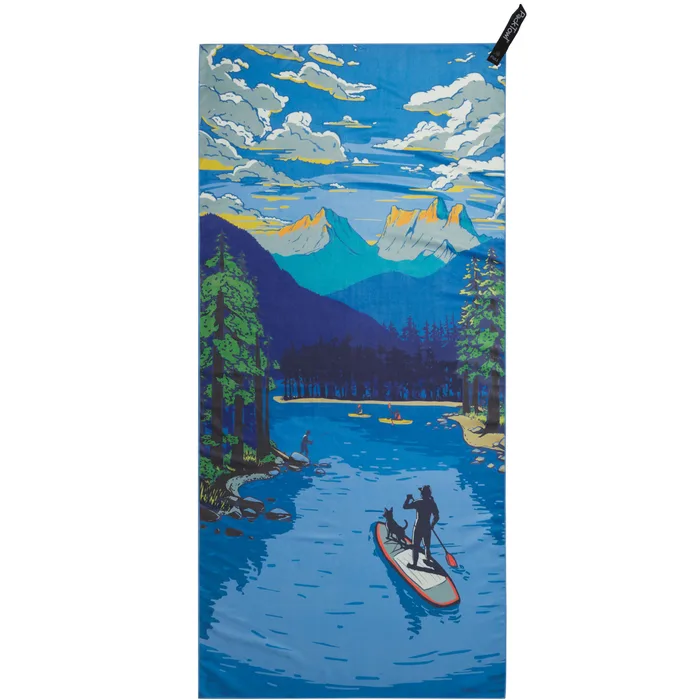
The PackTowl Personal is the pick for most people, and it is the only towel here that publishes a weight and a dimension for every size it sells, from a 0.7 ounce face cloth to a 9.7 ounce beach size. PackTowl states it absorbs 4 times its weight and dries 70 percent faster than comparable cotton. The Matador Ultralight Travel Towel is the one to take if pack space is the constraint: a stated 2.7 ounces for 47 by 24 inches, packing to 4.3 by 2.2 by 2.2 inches, which works out to roughly half the weight per unit area of the PackTowl body size. The Sea to Summit Drylite suits someone who wants a named fabric, being 80 percent recycled polyester with an ultra-suede finish that Sea to Summit says is lighter and more compact than its own Tek Towel. Skip the Nomadix Original for camping, because at 72.5 by 30 inches with no published absorbency or weight it is a beach and yoga towel wearing a travel label. Note that PackTowl is a Cascade Designs brand and is sold through MSR's own store. Best for: anyone willing to divide weight by area before buying.
Our picks at a glance
- PackTowl Personal Towel - Buy. The only towel here with a weight and a dimension published for every size, plus the two performance numbers the category is sold on.
- Matador Ultralight Travel Towel, Large - Buy. Full towel coverage at a stated 2.7 ounces, packing down to something you can close your hand around.
- Sea to Summit Drylite Towel - It depends. A named recycled fabric with a suede finish, positioned by its own maker as the lighter, more compact alternative to its bigger sibling.
- Nomadix Original Towel - Skip. A large, good-looking flat towel sold for travel, beach and yoga, which is a different job from drying yourself at a campsite.
The verdict in 30 seconds
What mattered most
- Published absorbency
- Published drying claim
- Stated weight
- Stated unpacked size
- Stated packed size
- Material
A camp towel is judged on three things: how much water it picks up, how fast it gives it back, and how little of your pack it occupies. The industry has settled on expressing the first as a multiple of the towel's own weight, which sounds precise and turns out not to be comparable, because nobody publishes a test method. What is comparable is weight against area, since several makers publish both, and that number varies by roughly two to one across this field. We read the four pages and did the arithmetic.
The only towel here with a weight and a dimension published for every size, plus the two performance numbers the category is sold on.
Best for: Most campers and travellers, and anyone who wants to pick a size from published numbers rather than guess.
- Four sizes with both figures stated: 0.7 oz at 10 by 14 in, 2.9 oz at 16.5 by 36 in, 6.4 oz at 25 by 54 in, and 9.7 oz for the beach size.
- PackTowl states it absorbs 4 times its weight in water, the highest published multiple in this comparison.
- Also states it dries 70 percent faster than comparable cotton towels, which is the figure that actually matters on a multi-day trip.
- Microfiber polyester and nylon blend, made from 50 percent recycled fabric.
- Wrings out easily, which is what makes a high absorbency figure usable rather than just heavy when wet.
- Heavier per unit area than the ultralight options, at roughly 20 grams per thousand square centimetres in the body size.
- PackTowl is a Cascade Designs brand sold through MSR's store, so shopping MSR and PackTowl is shopping one catalogue.
- No stated packed size, so you cannot tell how much pack volume it takes before it arrives.
- The absorbency multiple comes with no test method, so it is not strictly comparable to a rival's figure.
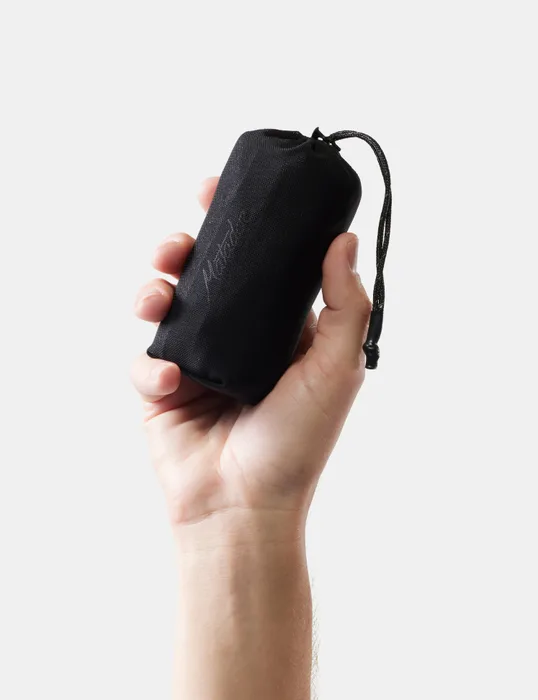
Full towel coverage at a stated 2.7 ounces, packing down to something you can close your hand around.
Best for: Backpackers, cyclists and one-bag travellers where packed volume decides what comes along.
- A stated 77 grams, or 2.7 ounces, for an unpacked 47 by 24 inches, which is about half the weight per unit area of the PackTowl body size.
- Packed dimensions published at 4.3 by 2.2 by 2.2 inches, which very few towel makers state at all.
- Nanofiber material, and Matador states the towel is PFAS-free.
- A carabiner buckle on the towel for hanging it, and machine washable.
- Matador claims absorbency of over twice its own weight, half the multiple PackTowl publishes.
- Being both very light and very thin, it needs wringing more often than a heavier towel.
- Most expensive towel here for the area you get.
- One size and one colour in this listing, so there is no smaller version for a day trip.

A named recycled fabric with a suede finish, positioned by its own maker as the lighter, more compact alternative to its bigger sibling.
Best for: Campers who care more about how a towel feels and what it is made of than about a headline absorbency number.
- Fabric composition published precisely: 80 percent recycled polyester and 20 percent polyamide, which Sea to Summit calls DRY+.
- Microfiber with an ultra-suede finish, which is noticeably more pleasant against skin than a plain waffle microfiber.
- Sea to Summit states it is lighter and more compact than its own Tek Towel, which is a useful internal comparison.
- Hang loop with a press stud and a mesh-faced storage pouch, so it can dry while packed.
- Offered in several sizes, so you can match it to whether you are drying a face or a body.
- No absorbency multiple published, which is the figure the rest of the category competes on.
- No drying-time claim either.
- The suede finish holds grit more readily than a smooth microfiber.
- Positioned against another Sea to Summit towel rather than against the field, which tells you less than it seems to.
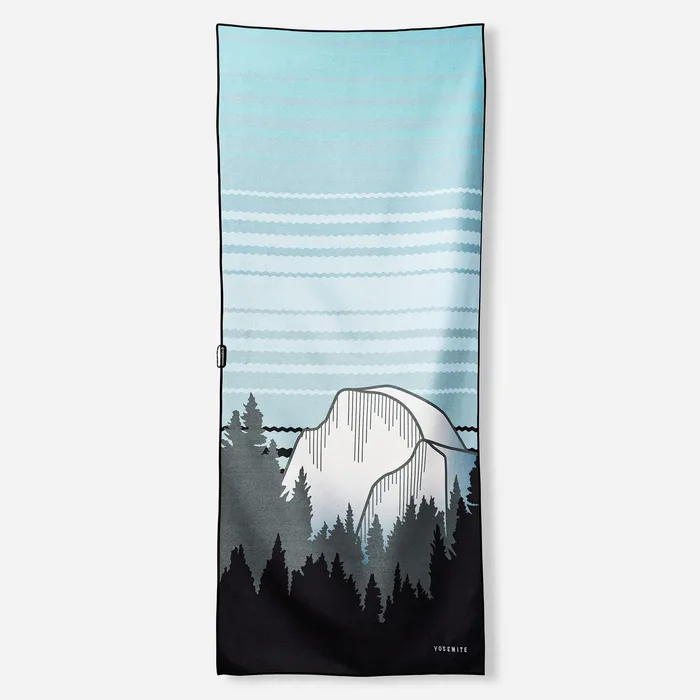
A large, good-looking flat towel sold for travel, beach and yoga, which is a different job from drying yourself at a campsite.
Best for: Beach days, van trips and yoga, where size and pattern matter more than packed volume.
- Large at a stated 72.5 by 30 inches, so it works as a beach towel, a mat or a groundsheet.
- Flat woven rather than pile, so it sheds sand well, which is the property it is really sold on.
- Made in a wide range of designs, including a National Parks collection, which is genuinely the reason most people buy one.
- No absorbency figure published anywhere on the product page.
- No towel weight published either, so it cannot be compared on weight per area against anything here.
- No packed size stated, on a product whose competitors compete on exactly that.
- At that size it is a beach and yoga towel, and the product page says so, which makes it the wrong tool for a pack.
| Criteria | Personal Towel | Ultralight Travel Towel, Large | Drylite Towel | Original Towel |
|---|---|---|---|---|
| Verdict | Buy it | Buy it | It depends | Skip it |
| Best for | Most campers and travellers, and anyone who wants to pick a size from published numbers rather than guess. | Backpackers, cyclists and one-bag travellers where packed volume decides what comes along. | Campers who care more about how a towel feels and what it is made of than about a headline absorbency number. | Beach days, van trips and yoga, where size and pattern matter more than packed volume. |
| Price tier | $$ · mid-range | $$$ · premium | $$ · mid-range | $$ · mid-range |
| Published absorbency | 4 times its weight | Over twice its weight | Not published | Not published |
| Published drying claim | 70 percent faster than comparable cotton | Quick drying, no figure | Fast drying, no figure | Not published |
| Stated weight | 0.7 oz, 2.9 oz, 6.4 oz and 9.7 oz by size | 2.7 oz (77 g) | Not published per size on the page | Not published |
| Stated unpacked size | 10x14 in, 16.5x36 in, 25x54 in by size | 47x24 in (119x61 cm) | Several sizes offered | 72.5x30 in |
| Stated packed size | Not published | 4.3x2.2x2.2 in (11x6x6 cm) | Mesh-faced storage pouch supplied | Not published |
| Material | Microfiber polyester and nylon, 50 percent recycled | Nanofiber, stated PFAS-free | DRY+ fabric, 80 percent recycled polyester and 20 percent polyamide | Not published |
| Weight per area, calculated | About 21 g per 1000 sq cm in the 25x54 in size | About 11 g per 1000 sq cm | Not calculable from published figures | Not calculable from published figures |
| Stated use | Camp and travel | Travel and backpacking | Backpack, beach tote or carry-on | Travel, beach and yoga |
Which one is right for you?
- Most campers and travellers, and anyone who wants to pick a size from published numbers rather than guess. Buy it PackTowl Personal Towel
- Backpackers, cyclists and one-bag travellers where packed volume decides what comes along. Buy it Matador Ultralight Travel Towel, Large
- Campers who care more about how a towel feels and what it is made of than about a headline absorbency number. It depends Sea to Summit Drylite Towel
- Beach days, van trips and yoga, where size and pattern matter more than packed volume. Skip it Nomadix Original Towel
How we judged the field
Five things decide a camp towel and only two of them get published consistently. The first is absorbency, expressed across this category as a multiple of the towel’s own weight, which sounds like a specification and behaves like a marketing claim because no maker states how it was measured. The second is drying speed, which matters more than absorbency on any trip past one night, and which exactly one maker here quantifies. The third is weight, the fourth is unpacked area, and those two together give the number we actually trust: fabric mass per unit area, which you can calculate whenever both figures are published. The fifth is packed size, which is what determines whether the towel comes along, and which almost nobody states.
So we sorted the field by what could be checked. PackTowl publishes a weight and a dimension for all four of its sizes, plus an absorbency multiple and a drying claim, which is the most complete disclosure in this comparison. Matador publishes a weight, an unpacked size and a packed size, which is rarer still, and a lower absorbency multiple. Sea to Summit publishes its fabric composition precisely and its performance figures not at all. Nomadix publishes a size. One brand note before the verdicts: the Personal Towel is sold on MSR’s own store and its vendor field reads PackTowl, because both are Cascade Designs brands, alongside Therm-a-Rest and Platypus. Shopping MSR and PackTowl separately is shopping one catalogue.
PackTowl Personal Towel - buy
The Personal is the towel we would tell most people to buy, and the reason is that you can make an informed size choice before it arrives. PackTowl publishes both a weight and a dimension for each of four sizes: 0.7 ounces at 10 by 14 inches for a face cloth, 2.9 ounces at 16.5 by 36 inches for a hand towel, 6.4 ounces at 25 by 54 inches for a body towel, and 9.7 ounces for the beach size. Nobody else here comes close to that. On top of it PackTowl states the two performance numbers the category competes on, absorbing 4 times its weight and drying 70 percent faster than comparable cotton, and notes that it wrings out easily, which is the property that makes high absorbency useful rather than merely heavy. The fabric is a microfiber polyester and nylon blend, half of it recycled. What it is not is the lightest option: run the arithmetic on the body size and it is around 21 grams per thousand square centimetres, roughly double the Matador.
Matador Ultralight Travel Towel, Large - buy
The Ultralight Travel Towel is the one that changes what you pack. Matador states 77 grams for an unpacked 47 by 24 inches, and crucially also publishes a packed size of 4.3 by 2.2 by 2.2 inches, which almost no towel maker does and which is the number that decides whether a towel makes the cut. Divide weight by area and it comes out around 11 grams per thousand square centimetres, about half the fabric mass of the PackTowl body size for a similar footprint. The material is described as nanofiber and Matador states it is PFAS-free, which is worth something in a category full of treated fabrics. There is a buckle on the towel for hanging. The honest costs are two. Matador claims absorbency of over twice its weight, against PackTowl’s 4 times, and a very light thin towel does need wringing more often. It is also the most expensive thing here per unit of area.
Sea to Summit Drylite Towel - it depends
The Drylite is the towel for somebody who cares what the fabric is. Sea to Summit publishes the composition exactly, 80 percent recycled polyester and 20 percent polyamide in what it calls DRY+ fabric, finished with an ultra-suede surface that feels considerably better against skin than the waffle-textured microfiber most technical towels use. It comes with a hang loop with a press stud and a mesh-faced storage pouch, which is a genuinely good detail because a mesh face lets a damp towel keep drying instead of sealing it in. Sea to Summit positions it as lighter and more compact than its own Tek Towel, which is useful if you are choosing between the two and tells you nothing about how it compares to anything else. That is the limitation: no absorbency multiple, no drying figure, and no weight or dimension in the description itself, so the only performance claim available is a comparison to a sibling product.
Nomadix Original Towel - skip
The Original is a good towel doing a different job. Nomadix states 72.5 by 30 inches, which is beach-towel size, and builds it as a flat woven towel rather than a pile one, which is why it sheds sand well and why it works as a yoga mat or a groundsheet. The designs are the real product; a National Parks collection is not something you buy on absorbency. What the page does not have is any of the numbers this category is judged on: no absorbency multiple, no weight, no packed size. For a beach day or a van trip none of that matters. For a camp towel it matters a great deal, because at that size and with no published weight you cannot tell what you would be carrying, and Nomadix’s own framing of travel, beach and yoga puts drying yourself at a campsite well down the list. Buy it for the beach and buy something else for the pack.
PackTowl Personal Towel vs Matador Ultralight Travel Towel, Large: which should you buy?
The PackTowl Personal and the Matador Ultralight are the two to choose between, and the question is whether the towel is carried or transported. PackTowl gives you four sizes with numbers attached, the highest published absorbency multiple at 4 times its weight, and the only drying claim in the field at 70 percent faster than cotton. It feels like a towel, wrings out properly, and costs less. If the towel lives in a car or a duffel, that is the end of the discussion.
Matador wins the moment pack volume is the binding constraint. Half the fabric mass per unit area, a published packed size of 4.3 by 2.2 by 2.2 inches, and 77 grams total, which is less than the PackTowl hand towel for more than twice the area. The trade is real: a lower published absorbency multiple, more frequent wringing, and a premium price. There is also a sensible middle path, which is to buy the PackTowl in the hand-towel size rather than the body size, since 2.9 ounces at 16.5 by 36 inches is enough towel for most people and closes much of the weight gap. Buy the PackTowl for value and information. Buy the Matador when grams and volume decide what comes.
What to look for
- Divide weight by area: it is the only comparable performance figure in this category, and it varies about two to one across these four.
- Treat absorbency multiples as class indicators: no maker here publishes a test method, so 4 times and over twice are not directly comparable.
- Look for a drying claim: it matters more than absorbency on a multi-day trip, and only one of these four quantifies it.
- Check for a packed size: it decides whether the towel comes along, and almost nobody states it.
- Buy a smaller size than you think: a hand towel dries an adult adequately and weighs a fraction of a body towel.
- Check who actually makes it: PackTowl sells through MSR’s store because both are Cascade Designs brands, so the two catalogues are one.
Our final take
This is a category sold on a number that cannot be compared and judged on one that rarely gets printed. Absorbency multiples make good packaging copy and mean little without a method; weight divided by area is checkable whenever a maker publishes both, and across these four it swings by about two to one. PackTowl’s Personal is the sensible default because it publishes a weight and a size for every option it sells, plus the only drying figure in the field. Matador’s Ultralight is the right answer when packed volume is what decides your kit list, and it is the only one here that tells you how small it gets. And a 72.5 inch flat towel sold for yoga is not a camp towel, however good it looks.
Questions, answered
What does absorbs four times its weight actually mean?
That a towel weighing 100 grams will hold about 400 grams of water before it stops picking any more up. It is a useful property, but it is not a standardised test and no maker in this comparison publishes a method, so the numbers are not strictly comparable between brands. PackTowl states 4 times and Matador states over twice, and some of that gap is likely to be measurement rather than performance. Treat the multiple as a rough class indicator and pay more attention to weight, area and how easily the towel wrings out.
How do I compare towels that come in different sizes?
Divide the stated weight by the stated area and you get a number you can actually use. Matador publishes 77 grams for 47 by 24 inches, which works out to roughly 11 grams per thousand square centimetres. PackTowl's 25 by 54 inch size is 6.4 ounces, or about 181 grams, which is roughly 21 grams over the same area. That is close to a two to one difference in fabric mass, and it explains both why the Matador packs smaller and why the PackTowl feels more substantial in the hand.
Is drying speed more important than absorbency?
On any trip longer than one night, yes. A towel that soaks up plenty and then stays damp goes into your pack wet, makes everything around it smell, and is unpleasant the next morning. PackTowl is the only maker here to publish a drying figure, stating 70 percent faster than comparable cotton. The practical version is to look for thin fabric with a large surface area and a hang loop, and to actually hang it rather than stuffing it away, because no fabric dries inside a pack.
Do I need a special camp towel at all?
For car camping, a normal towel is fine and cheaper. The case for a technical towel is packed volume and drying time, which only matter when you are carrying it. That is the line worth drawing: if the towel lives in a car, buy whatever feels nicest, and if it goes on your back, the difference between 77 grams packing to the size of a fist and a cotton towel is the difference between bringing one and not.
Why do microfiber towels start to smell?
Because they get stored damp and because fabric softener and body oils clog the fibres over time. The fix is unglamorous: wash them without fabric softener, which coats the microfiber and destroys its absorbency, and dry them fully before packing. A mesh-faced pouch, as Sea to Summit supplies with the Drylite, helps because it lets air through rather than sealing the damp in. If a towel already smells, a hot wash with a little vinegar and no softener usually recovers it.
Deciding between the top two? See our head-to-head: PackTowl Personal Towel vs Matador Ultralight Travel Towel, Large.
More Outdoors & Fitness reviews
 The Best Camping Chairs: 4 Compared (and One to Skip)
  The Best Camping Hammocks: 4 Compared (and One to Skip)
  The Best Camping Lanterns: 4 Compared (and One to Skip)
  The Best Camping Quilts: 4 Compared (and One to Skip)
  The Best Camping Stoves: 4 Compared (and One to Skip)
  The Best Camping Tables: 4 Compared (and One to Skip)