Explained
Suspension Seatposts, Explained
After reading, you'll know how to read a rider weight spec, why travel figures are nearly identical, and which spring type suits how you ride.
In this guide
A suspension seatpost looks like a simple upgrade and is usually sold on one number, travel, which turns out to be the number that varies least. What varies is the spring: how firm it is, whether the right one comes with the post, and how you change it. Get the spring wrong and a 35mm post behaves like a rigid one, or sits squashed at the bottom of its stroke. Read the rider weight spec first and the rest follows.
The 30-second version
- Rider weight is the spec that matters, and it appears as a window, a ceiling or a pressure chart depending on the brand.
- Travel figures barely differ, with most quality posts publishing around 35mm, so it is a poor way to choose.
- Check what ships in the box, because some posts include every spring and others include one out of five.
- Diameter can cap your limit, since a thinner post tube sets a lower rider ceiling than a fat one on the same design.
- Count your load, not your body weight, as panniers, a child seat or an e-bike battery all push you up the chart.
The products this guide is about
Our verdict on each, with the full reasoning on the companion review.
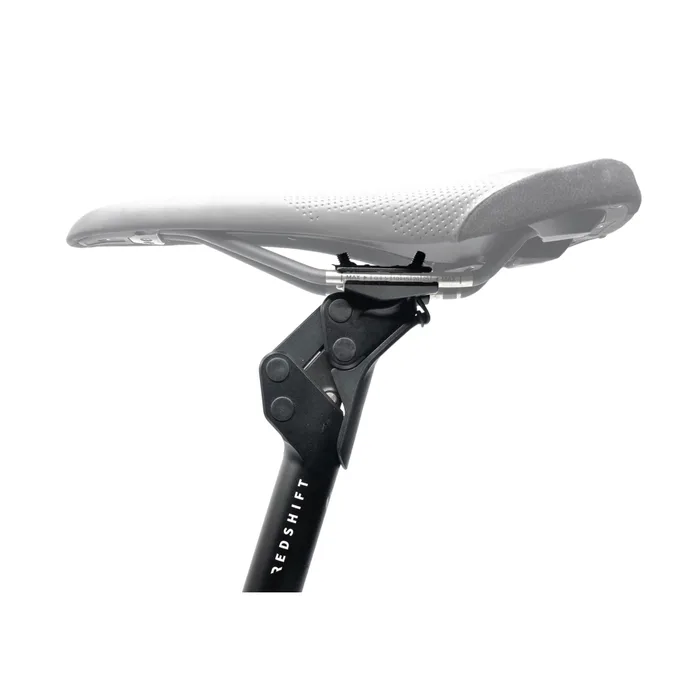
- Buy Redshift Sports ShockStop Endurance Suspension Seatpost A parallelogram linkage post with 35mm of travel that stays active while you are seated and pedalling, sold in more lengths and diameters than anything else here.
- Buy Cirrus Cycles Kinekt XR Aluminum Suspension Seatpost The only post here that states a full rider weight window rather than a ceiling, and it arrives with every spring you might need already in the box.
- It depends PNW Components Coast Suspension Dropper Post An air-sprung post that also drops, so it is tuned with a shock pump instead of a spring order, at the cost of being the heaviest and most complex thing here.
- Skip Cane Creek eeSilk+ The lightest tunable post here and the one with the lowest rider ceiling, shipped with a single elastomer that covers a 60 lb band in the middle of the range.
What actually matters
- Rider weight window - the range of rider weights a post is designed to carry. A window with a bottom as well as a top is more useful than a bare maximum, because it tells you when a post is too firm as well as when it is overloaded.
- Spring medium - coil, elastomer or air. Coils are linear and simple, elastomers are light and quiet, air is fully adjustable and needs a pump. Each is tuned in a different way, which affects living with the post.
- Suspension travel - how far the saddle can move. Useful as a category marker, but since most good posts land near 35mm it rarely decides anything between them.
- Linkage design - whether the post uses a parallelogram or a telescoping shaft. A linkage can keep the saddle angle roughly constant through travel and can remain active while you pedal seated.
- Post diameter and shim - your frame dictates 27.2, 30.9, 31.6mm or similar. Shims let you fit a smaller post in a bigger tube, but the post's own rider limit may be tied to its diameter.
- Length and minimum insertion - a long post on a small frame may not insert deep enough to be safe. A short option, around 280mm, is what makes suspension possible on compact frames.
- Setback - how far behind the seat tube the saddle sits. Suspension posts often have their own fixed setback, so fitting one can change your reach and saddle position noticeably.
The specs, in plain English
Green flags vs red flags
Green flags
- A rider weight window with both a minimum and a maximum, rather than a bare ceiling.
- Every spring or elastomer grade included in the box, so the post is usable on arrival.
- Weight published per size, so you know what a long post actually costs you.
- Multiple lengths including a short one, which means small frames are catered for.
- Published minimum and maximum extension figures so you can check fit before ordering.
Red flags
- Travel quoted prominently with no rider weight specification anywhere.
- A weight chart with overlapping or repeated bands, which makes the correct spring ambiguous.
- Springs or elastomers listed as separate purchases when only one ships installed.
- No published weight for the post itself.
- A single length offered, which usually means some frames cannot use it safely.
Who's who: the brands
- Redshift Sports - Known for parallelogram linkage posts and stems designed to stay active under pedalling, with wide size ranges and published rider limits per diameter.
- Cirrus Cycles - Makes the Kinekt posts, which publish full rider weight windows and ship with a complete set of springs and a hand-adjustable preload knob.
- Cane Creek - Long-standing suspension component maker whose eeSilk and Thudbuster posts cover the light elastomer end and the high-travel comfort end respectively.
- PNW Components - Dropper post specialist whose Coast model combines air suspension with dropper travel, tuned by pressure rather than by swapping springs.
How to read a listing without getting fooled
Go straight past the travel figure and find the weight specification, because that is what decides whether the post works under you. Note which form it takes: a window in pounds, a ceiling, or a pressure chart. If it is a ceiling, check whether it varies by diameter and look up which diameter your frame uses, since the narrower option often carries the lower limit. Next find the box contents and count the springs or elastomers, because a post supplied with one grade out of five is only correct for riders in that band. Then check the fit numbers, diameter, length, minimum insertion and setback, against your frame and your current saddle position. Only after all of that does weight become a reasonable tiebreaker.
How much should you spend?
The budget end of this category is mostly telescoping posts with a coil inside a tube, which do take the edge off but tend to stiffen when you pedal and rarely publish much. The mid-range is where linkage posts start, and it is the tier where you get real travel, a published rider limit and usually a spare spring. The premium tier splits two ways: paying for low weight, typically through carbon and an elastomer spring, or paying for capability, meaning a wide rider window with every spring included, or air suspension combined with a dropper. Since a mismatched spring ruins any of them, treat the completeness of the weight specification as part of what you are buying.
Questions, answered
Will a suspension seatpost slow me down?
A post adds a few hundred grams and some of them argue the suspension returns energy that would otherwise be spent bracing against bumps. On smooth surfaces you will feel the weight and nothing else. On rough ones, staying seated and pedalling instead of standing up is usually faster. Treat it as a comfort part that happens not to cost much speed.
Can I fit one to any bike?
Almost. You need the right diameter, or a shim, and enough seat tube for the post's minimum insertion. Long suspension posts are the problem on small frames, which is why a short option matters. Also check clearance behind the seat tube if you use a saddle bag, because the saddle moves down and back as it compresses.
How often do these need servicing?
Coil and elastomer posts mostly need the bolts checked and the moving parts kept clean, and elastomers eventually take a set and get replaced. Air posts need periodic pressure checks and have seals and a cartridge inside, so they carry more maintenance. Makers often decline to publish a fixed interval and suggest servicing by feel instead.
Do I need a suspension stem too?
Only if your hands and shoulders are the complaint. A seatpost addresses what reaches your seat; a compliance stem addresses what reaches your hands. Several brands sell both and will happily pair them, but they solve separate problems, so start with whichever end hurts.
Or jump to the head-to-head: Redshift Sports ShockStop Endurance Suspension Seatpost vs Cirrus Cycles Kinekt XR Aluminum Suspension Seatpost.