Explained
Retro Game Consoles, Explained
After reading, you'll understand what FPGA, upscaling and licensed catalogue mean, and how to match a console to the games you own.
In this guide
First-time buyers often assume any retro console plays any old game. It does not: some play your original cartridges, some play only their own cartridges, and some ship with a fixed list. Specs like FPGA, HDMI resolution and modules sound technical but decide real things, such as whether you need a PC or a separate controller. Reading what the maker actually lists beats trusting a product name.
The 30-second version
- Start with your shelf, because the games you own decide which consoles are even candidates.
- FPGA is a hardware approach, and Analogue describes the 3D as FPGA based instead of software emulation.
- Licensed cartridges are the safe route, as with the Evercade catalogue of officially licensed physical releases.
- Check what is in the box, since controllers, HDMI cables and power supplies are often extras.
- A missing spec is an unknown, so do not assume features the maker does not list.
The products this guide is about
Our verdict on each, with the full reasoning on the companion review.
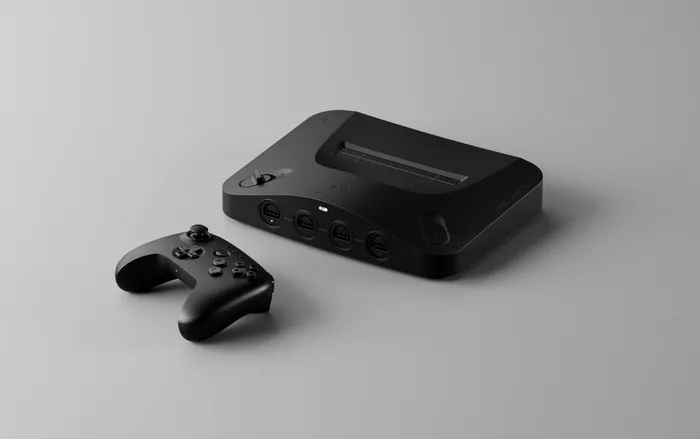
- Buy Analogue 3D A cartridge-based N64 console built on an FPGA chip rather than software emulation, with 4K HDMI output and four original-style controller ports. Amazon
- Buy Blaze Entertainment Evercade VS-R A two-slot cartridge console that plays officially licensed Evercade cartridges over 1080p HDMI, with a controller and four USB ports. Amazon
- It depends ModRetro M64 A cartridge-based N64 console from ModRetro with HDMI up to 4K, CRT filters, overclocking modes and wireless or wired updates.
- It depends Hyperkin RetroN 5 One console with slots for NES, Famicom, SNES, Super Famicom, Genesis, Mega Drive, Game Boy, Game Boy Color and Game Boy Advance cartridges. Amazon
- It depends Polymega Remix A disc and cartridge retro base unit that connects to a Windows PC over USB and runs the Polymega app, with cartridge support through separate modules.
- Skip Retro Games Ltd THEC64 Mini A 50% scale replica of the Commodore 64 with 64 built-in games, a joystick and 720p HDMI.
What actually matters
- Game source - This is whether the console plays original cartridges, discs, its own licensed cartridges or built-in titles. It decides whether your existing collection is useful.
- Hardware approach - FPGA recreates original circuit logic in hardware, while software emulation imitates it in code. Makers describe the approach differently, so read the product page.
- HDMI output - Retro consoles use HDMI to reach modern TVs, and listed resolutions range from 720p to 4K. A higher figure only helps if your TV and games benefit.
- Controller support - Some consoles keep original controller ports, some use USB, and some include a pad. Check both the ports and what is in the box.
- Standalone or PC-dependent - Most are self-contained, but the Polymega Remix needs a Windows 11 compatible PC running its app.
- Power and cables - Several consoles omit the HDMI cable or the power adapter. The cost is small but it can block a first session.
- Update support - Wireless updates can add features, but Analogue lists its WiFi updates as coming soon, so buy for what exists now.
The specs, in plain English
Green flags vs red flags
Green flags
- The maker page lists ports, video output and what is in the box.
- The console plays original or officially licensed cartridges and discs.
- Compatibility lists name specific systems.
- Limitations are stated plainly, such as no CRT support.
- A controller and power supply are included, or clearly listed as extras.
Red flags
- A product claims hundreds of built-in games with no licensing information.
- The page does not say what resolution the console outputs.
- Compatibility claims are vague or promise every game.
- Update features are promised but not yet available.
- Accessories required to play are not mentioned.
Who's who: the brands
- Analogue - Known for FPGA-based consoles that play original cartridges, including the 3D and the Duo.
- Blaze Entertainment (Evercade) - Maker of the Evercade platform of officially licensed physical cartridges.
- Hyperkin - Sells multi-system retro consoles and controllers, including the RetroN line.
- Polymega - Builds a modular system for discs and cartridges across many retro systems.
- ModRetro - Makes the M64 for original N64 cartridges and sells it in several colours.
How to read a listing without getting fooled
Open the maker page and look for the product's spec table before the marketing copy. Find the game source, the video output, the ports, the box contents and any stated limitations such as CRT support or a PC requirement. Ignore claims you cannot trace to a listed feature, and treat 'coming soon' as not yet available. If a page has only a description, as with the ModRetro M64, note what is unknown before you buy.
How much should you spend?
Retro consoles span three tiers. Budget to mid-range sits with the plug-and-play and licensed cartridge options, where the console is cheap but you keep buying games. Mid-range covers multi-system boxes and the Polymega Remix, where modules and controllers add to the total. Premium covers the FPGA and 4K-capable N64 consoles. Remember that the real cost is the console, the controller, the cables and the games, so add them up.
Questions, answered
Is the Analogue 3D better than the ModRetro M64?
Both target original N64 cartridges and controllers. The Analogue 3D lists its ports, box contents and dimensions on its page, while the ModRetro M64 page is a description without a spec table. The M64 lists CRT filters and overclocking modes. Choose on the features you want and how much documentation matters.
Can the Evercade VS-R play my old cartridges?
No. It plays Evercade cartridges, which Blaze describes as officially licensed physical releases. It will not take original Nintendo, Sega or Atari cartridges.
Why does the Polymega Remix need a PC?
Polymega designed the Remix base unit to connect over USB to a Windows 11 compatible device running the Polymega app. It provides the optical drive and cartridge module connections while the PC does the processing.
Is THEC64 Mini a full Commodore 64?
It is a 50% scale replica with 64 built-in games and a BASIC programming mode that saves to USB sticks. The maker also sells a separate full-size THEC64, which this review does not cover.
Or jump to the head-to-head: Analogue 3D vs Blaze Entertainment Evercade VS-R.