Explained
Jigsaw Puzzle Boards, Explained
After reading, you'll understand how to match a board to your puzzle and which listing details to trust.
In this guide
First-time buyers often pick a board by piece count and then find the finished puzzle does not fit. Listings also mix rotating boards, tilting tables and roll-up mats under the same name. The sections below explain the terms and what a good listing should state.
The 30-second version
- Size is finished size, so check the finished puzzle dimensions, not only the piece count.
- Felt keeps pieces still, and rigid boards usually rely on a mat or raised border.
- Drawers sort pieces, and the count should be stated, not implied.
- A cover protects work in progress, so you can leave a puzzle for days.
- Rolling mats store a puzzle but do not sort it, so they pair with trays.
The products this guide is about
Our verdict on each, with the full reasoning on the companion review.
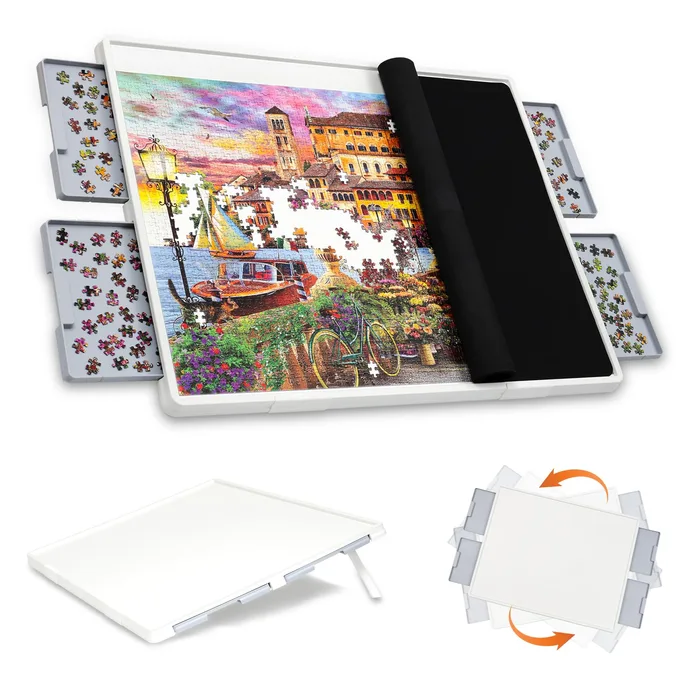
- Buy Playboda 1500-Piece Rotating & Tilting Puzzle Table (PB-1500R) A rigid plastic board that spins on a base, tilts on a stand and has four sorting drawers, sized for 1500 pieces. Amazon
- Buy Bits and Pieces Felt Puzzle Plateau Board and Organizer A felt-covered board with four removable drawers and a removable PVC cover that the maker says is three times lighter than traditional wooden models.
- It depends VEVOR 1500 Piece Puzzle Table with Folding Legs (SJ-08) A pine table with folding legs, four drawers and a six-position tilt bracket, sized for 1500-piece puzzles. Amazon
- It depends Cobble Hill Puzzle Roll Away Mat A felt mat with a rolling tube and hook-and-loop straps so an unfinished puzzle can be rolled up with the pieces in place.
- It depends Jumbo Puzzle Mates Portapuzzle Board (up to 1000 pieces) A simple board for building, sorting and storing an unfinished puzzle, made for standard 1000 piece puzzles of about 68 by 49 cm. Amazon
- Skip Buffalo Games Wooden Puzzle Table with Drawers (2000 piece) A large wooden board with drawers for 2000-piece puzzles, whose maker page publishes very little beyond size, material and weight.
What actually matters
- Finished size - the puzzle's size when complete. It decides whether the board fits at all.
- Piece capacity - the maximum the maker says the board takes. It is only a guide, because the same count finishes at different sizes.
- Surface - felt, rubber or plastic. It decides whether pieces slide, especially when tilted.
- Drawers - sorting trays that slide out. More drawers means more room to sort by colour or edge.
- Cover - a lid or sheet over the board. It protects a work in progress and lets you stack the board.
- Tilt and rotation - an angled surface and a turning base. They reduce leaning and let you reach every side.
- Weight - how heavy the board is. It decides how easily you can carry it between rooms.
The specs, in plain English
Green flags vs red flags
Green flags
- The page states the board size in inches or centimetres.
- A weight is published.
- The drawer count is stated.
- The cover is described and shown.
- A clear warranty or guarantee period is given.
Red flags
- Two different sets of dimensions on the same page.
- No drawer count on a board sold as having drawers.
- No weight or material listed.
- A piece capacity with no size given.
- One page covering several variants without saying which is which.
Who's who: the brands
- Playboda - A puzzle-accessory maker known for rotating and tilting boards with drawers.
- Bits and Pieces - A puzzle and gift retailer with its own range of plateaus and felt boards.
- Cobble Hill - A jigsaw puzzle maker that also sells a roll away mat for its own puzzles.
- Jumbo - A European puzzle maker whose Puzzle Mates line covers boards and mats.
- VEVOR - A broad hardware and home brand that sells folding puzzle tables.
How to read a listing without getting fooled
Start with the size line and check it against the finished size of your puzzle. Then look for the drawer count, whether a cover is included, the weight and the material. If two sets of dimensions appear, or a feature is only in the title, treat it as unconfirmed. Pages that state a tilt in degrees or a guarantee in months are easier to trust than ones that use only adjectives.
How much should you spend?
Plain boards and roll-up mats sit in the budget tier, while felt boards with drawers and a cover and rotating or folding tables sit in the mid-range tier. A higher tier buys drawers, a cover and a tilt, not a better surface. Pay for the features you will actually use, such as the cover if you leave puzzles for days.
Questions, answered
Can I use a roll-up mat for a 1000 piece puzzle?
Yes, if the mat is larger than the finished puzzle. The Cobble Hill mat measures 30.5 by 47 inches and the maker says it suits its own 1000 and 500 piece puzzles. Check the finished size of your puzzle against the mat.
Do felt boards need a cover?
A cover is optional but useful. It keeps dust and pets off a work in progress and lets you stack the board. The Bits and Pieces board includes a removable PVC cover.
Why does the tilt angle matter?
A steeper tilt brings the puzzle closer but makes pieces more likely to slide. A surface that grips, such as felt or a rubber mat, helps. The VEVOR table shows six positions.
Is a wooden board better than plastic?
Wood is sturdier and heavier, and plastic is rigid and often lighter. The Playboda uses recyclable ABS plastic and the VEVOR uses pine. Choose on weight, feel and how often you move it.
Or jump to the head-to-head: Playboda 1500-Piece Rotating & Tilting Puzzle Table (PB-1500R) vs Bits and Pieces Felt Puzzle Plateau Board and Organizer.