

Tools & DIY · Head-to-head
Fluke 62 MAX+ vs Klein Tools IR10 Dual-Laser Infrared Thermometer
Which should you buy? Our verdict on both, pulled from our full The Best Infrared Thermometers: 4 Compared (and One to Skip) comparison.
The Fluke wins on how its numbers are stated rather than on how big they are, which is the thing that separates a usable reading from a plausible one. The Klein gets you a tighter optic and a contact probe for less, and gives up some accuracy and some disclosure to do it.
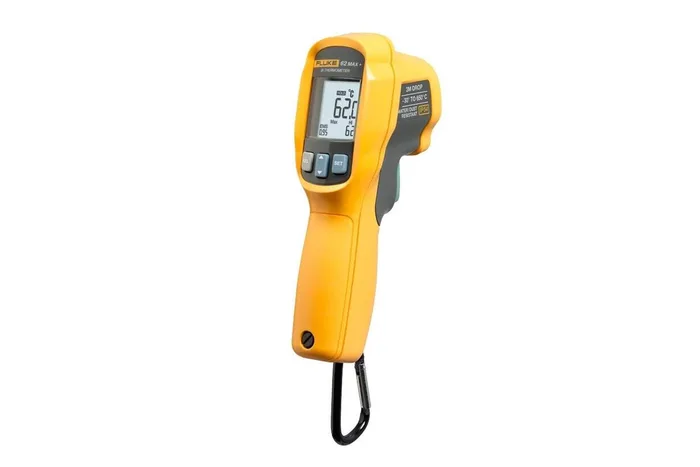
Fluke 62 MAX+
Buy itThe one that tells you what its distance-to-spot ratio actually means.
- Fluke publishes the 12:1 optic as calculated at 90 percent energy, so the ratio has a defined basis instead of being an unexplained number.
- Accuracy is the greater of 1.0 C or 1.0 percent of reading, with separate 2.0 C and 3.0 C bands stated for the sub-zero ranges.
- Rated IP54 per IEC 60529, tested to a 3 meter drop, and runs on a single AA alkaline cell.
- No contact probe input, so air, gas, liquid and internal temperatures are out of reach entirely.
- The 12:1 optic reads a wider spot at any given distance than the Klein's 20:1 optic.
- Fluke rates it at 8 hours with laser and backlight on, the shortest of the three MAX-series guns on the same datasheet.
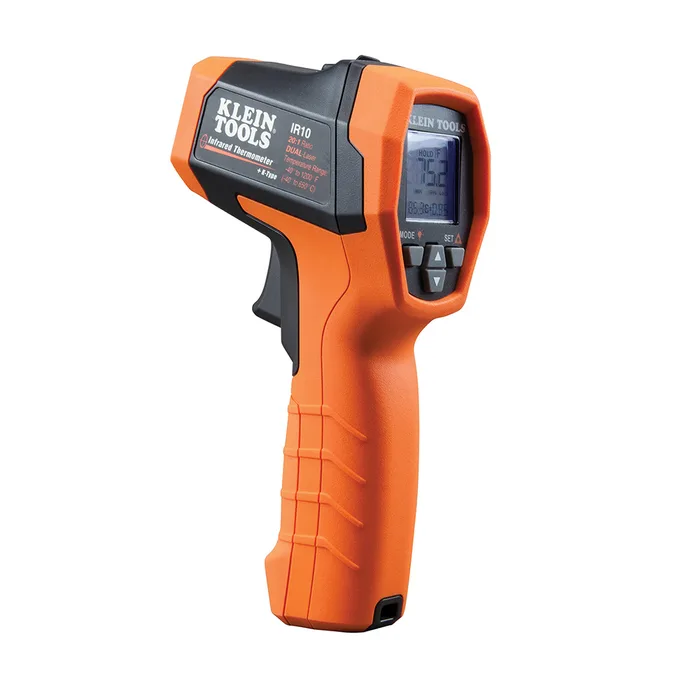
Klein Tools IR10 Dual-Laser Infrared Thermometer
Buy itTightest optic here, plus the contact probe that covers what infrared cannot.
- 20:1 optical resolution, the tightest of the four, and the manual charts the spot diameter at 10, 20, 40 and 80 inches.
- A K-type probe is included for what Klein calls bulk temperatures of air, gas, or liquids, which the infrared sensor cannot measure.
- Emissivity adjusts 0.10 to 1.00 and the printed manual carries an emissivity chart for asphalt, brick, concrete, glass, marble, copper, sheet aluminum and cold rolled steel.
- The 20:1 figure is published as a bare ratio with no energy fraction stated, unlike the Fluke.
- Infrared accuracy is 3 F (1.5 C) or 1.5 percent whichever is greater, looser than the Fluke's 1.0 C or 1.0 percent.
- The bundled K-type probe is rated only to 356 F (180 C); anything hotter needs a separate high-temp probe.
Side by side
The 8 criteria below are the ones our full comparison judged every product on, narrowed to these two.
| Fluke 62 MAX+ Our pick | Klein Tools IR10 Dual-Laser Infrared Thermometer | |
|---|---|---|
| Our verdict | Buy | Buy |
| Best for | Electricians and HVAC techs who need a rugged spot reading they can put in a report. | Tradespeople who want one tool that reads both a hot surface and the air coming out of a vent. |
| Price tier | $$$ · premium | $$ · mid-range |
| Temperature range | -30 to 650 C (-22 to 1202 F) | -40 to 650 C (-40 to 1200 F) |
| Stated accuracy above freezing | 1.0 C or 1.0% of reading, greater of | 3 F (1.5 C) or 1.5%, greater of |
| Distance-to-spot, as published | 12:1, calculated at 90% energy | 20:1, bare ratio |
| Emissivity | Adjustable 0.10 to 1.00 | Adjustable 0.10 to 1.00 |
| Contact probe input | None | K-type probe included, rated to 356 F (180 C) |
| Drop and ingress rating | 3 m drop, IP54 per IEC 60529 | 3 m drop, IP54 |
| Power | 1 x AA alkaline, 8 h with laser and backlight | 1 x 9V alkaline, 8 h continuous |
| Calibration paperwork | Verification procedure published in the manual | Stated accurate for one year |
Which one is right for you?
Pick the Fluke 62 MAX+ if
electricians and HVAC techs who need a rugged spot reading they can put in a report.
Know before buying: no contact probe input, so air, gas, liquid and internal temperatures are out of reach entirely.
Pick the Klein Tools IR10 Dual-Laser Infrared Thermometer if
tradespeople who want one tool that reads both a hot surface and the air coming out of a vent.
Know before buying: the 20:1 figure is published as a bare ratio with no energy fraction stated, unlike the Fluke.
The bottom line
Our overall pick is the Fluke 62 MAX+ - The one that tells you what its distance-to-spot ratio actually means. Choose the Klein Tools IR10 Dual-Laser Infrared Thermometer instead if tradespeople who want one tool that reads both a hot surface and the air coming out of a vent.
Want the full picture, including the other options we compared and the popular one we'd skip? Read the complete The Best Infrared Thermometers: 4 Compared (and One to Skip).