

Tech & Gadgets
The Best Telescopes: 4 Compared (and One to Skip)
We compared Celestron's StarSense Explorer 114mm, Sky-Watcher's Heritage 130, Celestron's Travel Scope 50 and the PowerSeeker 70AZ on aperture, mount, ease of use and beginner reality.
The short version
The Celestron StarSense Explorer 114 is our telescope gift pick: a 114mm tabletop Dob whose app finds objects for you, premium tier. The Sky-Watcher Heritage 130 is the purist pick - more aperture, no app, also premium tier. The Travel Scope 50 is the budget-tier portable it-depends, 2.2 lb with the backpack. Skip the PowerSeeker 70AZ - Celestron has discontinued it, and its own 165x useful limit sits below the 175x and 525x its included eyepiece and Barlow produce.
Our picks at a glance
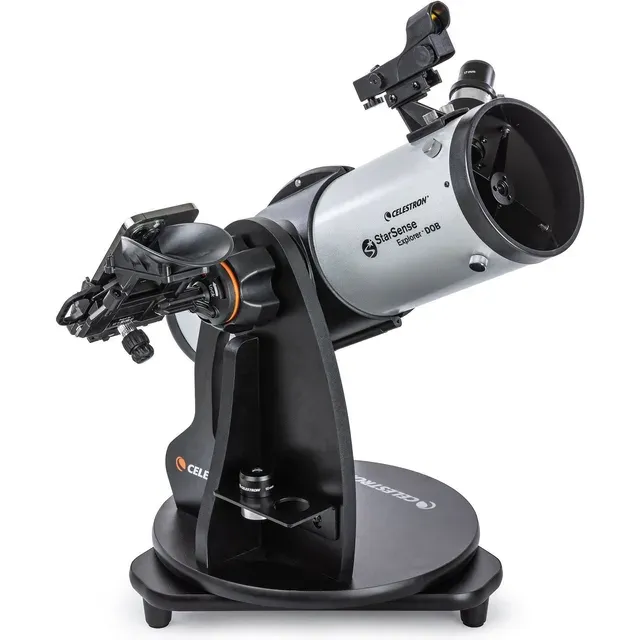
- Celestron StarSense Explorer 114mm Tabletop Dobsonian - Buy. A 114mm f/4 tabletop Dobsonian that uses your phone to actually find objects - a beginner-friendly scope.
- Sky-Watcher Heritage 130 Tabletop Dobsonian - Buy. A 130mm collapsible tabletop Dobsonian - more aperture than the Celestron, no app needed.
- Celestron Travel Scope 50 - It depends. A 50mm grab-and-go refractor with backpack - the budget-tier, 2.2 lb kid scope and daytime spotter.
- Celestron PowerSeeker 70AZ - Skip. A 70mm f/10 refractor on a light alt-azimuth tripod that Celestron now lists as discontinued - and whose own spec sheet shows the magnification problem.
The verdict in 30 seconds
What mattered most
- Aperture
- Mount
- Finding objects
- Included eyepieces
- Highest useful magnification (maker)
- Portability
A telescope is the gift that gets used on one clear night a year - unless it's the right one. The difference between a scope that shows Saturn's rings and one that shows wobble is aperture and a stable mount, not the magnification printed on the box. We compared two tabletop Dobsonians, a grab-and-go travel scope and the long-tube refractor on a light tripod that beginners are so often given, working from each maker's published specifications.
A 114mm f/4 tabletop Dobsonian that uses your phone to actually find objects - a beginner-friendly scope.
Best for: The first real telescope gift - a scope that finds things for you so the first night ends in wonder, not frustration.
- StarSense app navigation: dock your phone and the app reads the sky, then on-screen arrows guide you to targets and a bullseye turns green when the object is in the eyepiece.
- 114mm (4.5 inch) parabolic primary mirror, 450mm focal length at f/4 - real aperture that Celestron says shows Jupiter's cloud bands, Saturn's rings and the Orion Nebula's trapezium.
- Tabletop Dobsonian base with an altitude brake - stable, no tripod to wobble, intuitive point-and-push aiming, and 12.6 lb for the whole kit.
- Ships with 17mm (26x) and 10mm (45x) Kellner eyepieces, a StarPointer red-dot finder, an eyepiece rack and a collimation cap, so it works without the phone too.
- Premium tier, so it is a bigger spend than a stocking-stuffer scope.
- Needs a table or level surface - it's a tabletop scope, and Celestron sells the tripod separately.
- Phone-dependent for the guided finding - the StarSense dock needs your smartphone, so it's less ideal for a phone-free kid.
Own the Celestron StarSense Explorer 114mm Tabletop Dobsonian? Tell us how it held up.
Thanks. Counted, and shown once enough owners have weighed in.
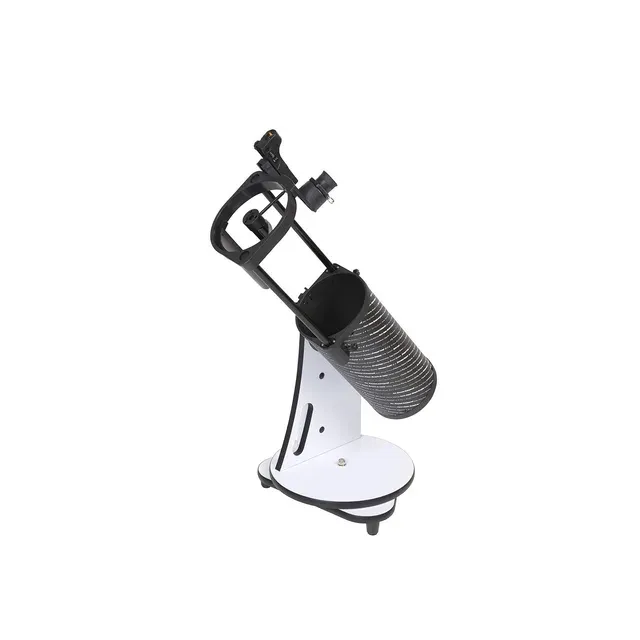
A 130mm collapsible tabletop Dobsonian - more aperture than the Celestron, no app needed.
Best for: A beginner who wants max aperture for the money and will learn to star-hop - the purist's tabletop scope.
- 130mm borosilicate parabolic primary mirror with Sky-Watcher's Radiant Aluminum Quartz coating, 650mm focal length at f/5 - more light-gathering than the 114mm Celestron.
- Collapsible tube design that Sky-Watcher says retains collimation while shrinking the scope for storage and travel.
- Tabletop Dobsonian base with Teflon bearings, an altitude locking knob and vibration-damping rubber feet - stable, simple, intuitive aiming.
- 1.25-inch helical focuser and a mirror the maker rates for planets, galaxies and nebulae.
- No guided finding - you aim by hand and star-hop, and Sky-Watcher's product page lists no finder or eyepieces among the included items, so check the retailer's box contents.
- Tabletop mount needs a surface - same caveat as the Celestron.
- Collapsible tubes expose the light path to stray light and dew; a shroud is a common add-on.
Own the Sky-Watcher Heritage 130 Tabletop Dobsonian? Tell us how it held up.
Thanks. Counted, and shown once enough owners have weighed in.
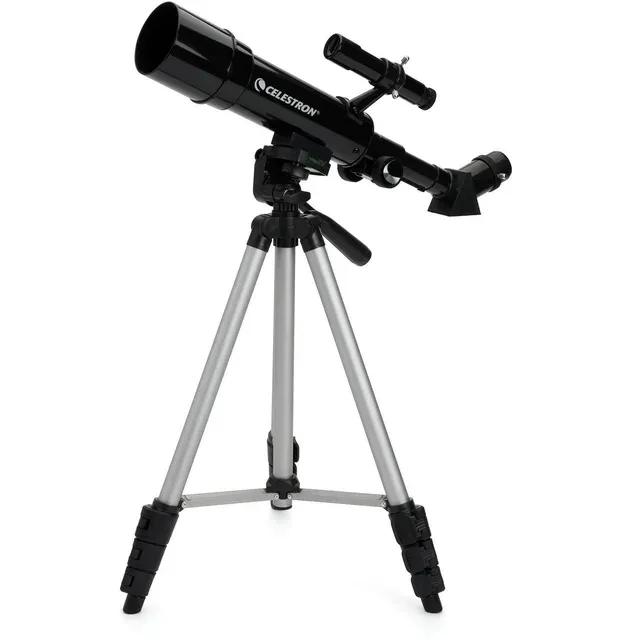
A 50mm grab-and-go refractor with backpack - the budget-tier, 2.2 lb kid scope and daytime spotter.
Best for: A kid's first scope or a travel scope - Moon, planets and daytime spotting in a backpack, not deep-sky chasing.
- Backpack included and the whole kit weighs 2.2 lb - the portable scope for a kid or a camping trip.
- 50mm f/7.2 refractor (360mm focal length) that Celestron says shows the Moon, planets, star clusters and the brighter deep sky objects such as the Orion Nebula.
- 45-degree erect-image diagonal doubles it as a daytime spotting scope - more usable than a night-only scope.
- Ships with 20mm (18x) and 8mm (45x) eyepieces, a 3x Barlow and a 2x20 finderscope, and sets up in minutes.
- 50mm is small - Celestron's rated highest useful magnification is 120x; this is a Moon-and-planets scope, not a galaxy machine.
- Lightweight adjustable tripod - the price of a 2.2 lb package.
- The 3x Barlow pushes the 8mm eyepiece to 135x, past the maker's own 120x useful limit, so the top magnification is on paper only.
Own the Celestron Travel Scope 50? Tell us how it held up.
Thanks. Counted, and shown once enough owners have weighed in.
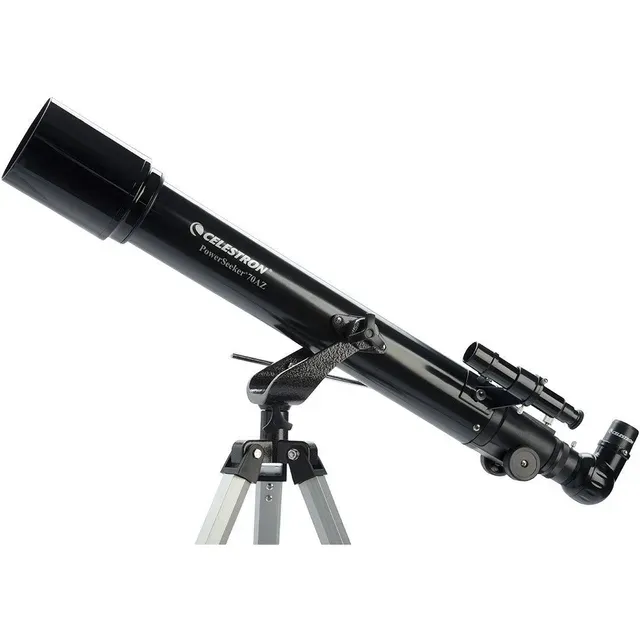
A 70mm f/10 refractor on a light alt-azimuth tripod that Celestron now lists as discontinued - and whose own spec sheet shows the magnification problem.
Best for: Nobody buying new - the same mid-range money goes toward a tabletop Dobsonian, or a budget-tier travel scope if portability is the point.
- 70mm aperture and a 700mm focal length - a long, slow f/10 refractor that is forgiving on the planets when it holds still.
- Includes 20mm (35x) and 4mm (175x) eyepieces, a 3x Barlow, an erect-image diagonal, a 5x24 finderscope and a tripod with an accessory tray, so it also works as a daytime spotter.
- Celestron's own specifications rate the highest useful magnification at 165x, yet the included 4mm eyepiece gives 175x and 525x with the Barlow - accessories that promise views the maker's own figure says the optics cannot deliver.
- Celestron now marks the PowerSeeker 70AZ as discontinued and out of stock on its own site, so remaining units are old retailer inventory.
- A light alt-azimuth tripod with a slow-motion rod is the mount type most prone to vibration at high power, which is exactly where the 4mm eyepiece and Barlow push a beginner.
- A 5x24 finderscope is the smallest optical finder format; the StarSense ships a red-dot and the Travel Scope a 2x20.
Own the Celestron PowerSeeker 70AZ? Tell us how it held up.
Thanks. Counted, and shown once enough owners have weighed in.
| Criteria | Celestron StarSense Explorer 114mm Tabletop Dobsonian Top pick Buy it Buy | Sky-Watcher Heritage 130 Tabletop Dobsonian Buy it Buy | Celestron Travel Scope 50 It depends Buy | Celestron PowerSeeker 70AZ Skip it Buy |
|---|---|---|---|---|
| Best for | The first real telescope gift - a scope that finds things for you so the first night ends in wonder, not frustration. | A beginner who wants max aperture for the money and will learn to star-hop - the purist's tabletop scope. | A kid's first scope or a travel scope - Moon, planets and daytime spotting in a backpack, not deep-sky chasing. | Nobody buying new - the same mid-range money goes toward a tabletop Dobsonian, or a budget-tier travel scope if portability is the point. |
| Price tier | $$$ · premium | $$$ · premium | $ · budget | $$ · mid-range |
| Aperture | 114mm reflector, f/4 | 130mm reflector, f/5 | 50mm refractor, f/7.2 | 70mm refractor, f/10 |
| Mount | Tabletop Dobsonian | Tabletop Dobsonian | Lightweight tripod | Alt-az tripod, slow-motion rod |
| Finding objects | StarSense phone app + red-dot finder | Manual star-hopping (finder not listed by maker) | 2x20 finderscope | 5x24 finderscope |
| Included eyepieces | 17mm (26x), 10mm (45x) | Not listed by maker | 20mm (18x), 8mm (45x), 3x Barlow | 20mm (35x), 4mm (175x), 3x Barlow |
| Highest useful magnification (maker) | 269x | Not published | 120x | 165x |
| Portability | Tabletop, 12.6 lb kit | Collapsible tube | Backpack, 2.2 lb kit | Long tube and tripod |
| Price tier | $$$ · premium | $$$ · premium | $ · budget | $$ · mid-range |
| Beginner reality | Easiest to use | Needs some learning | Easy but limited | Discontinued; poor at high power |
Which one is right for you?
- The first real telescope gift - a scope that finds things for you so the first night ends in wonder, not frustration. Buy it Celestron StarSense Explorer 114mm Tabletop Dobsonian
- A beginner who wants max aperture for the money and will learn to star-hop - the purist's tabletop scope. Buy it Sky-Watcher Heritage 130 Tabletop Dobsonian
- A kid's first scope or a travel scope - Moon, planets and daytime spotting in a backpack, not deep-sky chasing. It depends Celestron Travel Scope 50
- Nobody buying new - the same mid-range money goes toward a tabletop Dobsonian, or a budget-tier travel scope if portability is the point. Skip it Celestron PowerSeeker 70AZ
How we judged the field
A gift telescope lives or dies on one thing: whether the recipient can actually find and see something. The category’s trap is the long refractor promising huge magnification on a mount too light to use it. We compared two tabletop Dobsonians (the real beginner format), a portable travel scope and the PowerSeeker on aperture, mount, included accessories and the maker’s own “highest useful magnification” figure, which is the number that exposes an over-promising box.
Celestron StarSense Explorer 114mm Tabletop
Buy itThe StarSense Explorer solves the beginner’s real problem - finding things. Dock a phone in the mount, launch the app, align it to the optics, and the app generates a list of what is visible tonight; pick a target and on-screen arrows walk you to it, with a bullseye that turns green when the object is in the eyepiece. Underneath is a 114mm (4.48 inch) parabolic primary mirror at 450mm focal length, f/4, in a steel tube on a tabletop Dobsonian base with Teflon bearings, an altitude brake for smooth tracking, and an eyepiece rack. Celestron lists the included items as 17mm and 10mm Kellner eyepieces (26x and 45x), a StarPointer red-dot finder, the StarSense dock and unlock code, and a collimation cap; the whole kit weighs 12.6 lb and the maker rates the highest useful magnification at 269x.
It is premium tier, it needs a table or level surface (Celestron sells a matching tripod separately), and the guided finding needs a docked smartphone, so it is the serious pick rather than a casual toy. But it works, and the red-dot finder means it still aims when the phone is flat. For a first real telescope gift, it is the one that ends in wonder rather than frustration.
Sky-Watcher Heritage 130 Tabletop
Buy itThe Heritage 130 trades the app for aperture: a 130mm borosilicate parabolic mirror with Sky-Watcher’s Radiant Aluminum Quartz coating, 650mm focal length at f/5 - more light-gathering than the Celestron in the same premium tier. The tube collapses for storage and transport, and Sky-Watcher says the design retains collimation when it is extended again, which removes the maintenance worry that collapsible scopes usually carry. The base uses Teflon bearings, an altitude locking knob and skid-resistant, vibration-suppressing rubber feet, and the focuser is a 1.25-inch helical.
It is the purist’s pick. There is no guided finding - you star-hop by hand - and Sky-Watcher’s product page does not list a finder or eyepieces among the included items, so check the box contents with the retailer before gifting. The open truss also lets in stray light and dew, and many owners add a cloth shroud. For a beginner who will learn the sky, the 130mm mirror and simple mount make it the best aperture for the money here.
Celestron Travel Scope 50
It dependsThe Travel Scope is the budget-tier pick: a 50mm f/7.2 refractor (360mm focal length) with an aluminum tube, a 45-degree erect-image diagonal, 20mm and 8mm eyepieces (18x and 45x), a 3x Barlow, a 2x20 finderscope, an adjustable tripod and a custom backpack that holds all of it; Celestron puts the total kit at 2.2 lb. The maker says it shows the Moon, planets, star clusters and the brighter deep-sky objects, and the erect-image diagonal makes it a daytime spotting scope too.
Whether it is right depends on expectations. For a kid’s first taste or a camping scope, it delivers real views in the budget tier and it travels. But 50mm is small: Celestron rates the highest useful magnification at 120x, which means the Barlow’s 135x with the 8mm eyepiece is a number on the box rather than a view you will use, and the lightweight tripod is the price of a 2.2 lb package. It is a Moon-and-planets starter, not a deep-sky scope. Buy it knowing it is a taste, not the meal.
Celestron PowerSeeker 70AZ
Skip itTwo facts decide this one, and both come from Celestron. First, the company now lists the PowerSeeker 70AZ as discontinued and out of stock on its own site, so anything on sale is remaining retailer inventory. Second, the spec sheet: a 70mm f/10 refractor (700mm focal length) with a highest useful magnification of 165x, shipped with a 20mm eyepiece (35x), a 4mm eyepiece (175x) and a 3x Barlow that takes the 4mm to 525x. The included accessories produce magnifications the maker’s own figure says the optics cannot use, and the mount - a light alt-azimuth tripod with a slow-motion rod and accessory tray - is the type most prone to vibration at exactly those powers.
The scope is not optically useless: a 70mm f/10 shows the Moon and Jupiter’s moons at 35x, and the erect-image diagonal gives daytime use. But the 5x24 finderscope is the smallest optical finder format, and a beginner reaching for the 4mm eyepiece because it came in the box gets a dim, shaking image. That is the pattern behind the first scope that ends up in a closet, and in the same mid-range tier the money is better spent toward a tabletop Dobsonian.
Sources
Specs in this review come from these pages.
StarSense 114 vs Heritage 130: which should you buy?
Both are tabletop Dobsonians in the premium tier. The StarSense 114 adds phone-guided object finding, a listed accessory set and a red-dot finder; the Heritage 130 gives you a larger mirror, a collapsible tube and manual aiming with no published finder.
Buy the StarSense for a true beginner - the finding is the value. Buy the Heritage if they will learn to star-hop - the extra aperture shows more.
What to look for
- Aperture over magnification: the mirror or lens diameter is the real spec. Compare the maker’s “highest useful magnification” with what the included eyepieces produce; if the eyepieces exceed it, the box is over-promising.
- The mount is half the scope: a light tripod ruins good optics. Tabletop Dobsonians are the stable beginner format.
- Finding is the hard part: scopes do not aim themselves - the StarSense app solves it, or you learn to star-hop. Check that a finder is actually listed.
- Tabletop needs a table: the small Dobs are grab-and-go but want a level surface.
- Buy for what they will see: Moon and planets are easy; galaxies need aperture and dark skies.
- Check the maker’s status: a scope the manufacturer has discontinued is old inventory at any price.
Our final take
The Celestron StarSense Explorer 114 is our telescope gift pick - a 114mm Dob that finds objects for you, premium tier. The Sky-Watcher Heritage 130 is the aperture-first purist pick in the same tier. The Travel Scope 50 is the budget-tier starter at 2.2 lb. Skip the PowerSeeker 70AZ - discontinued by Celestron, with included eyepieces that exceed the maker’s own useful limit. Prioritise aperture and a stable mount, and give a scope that gets used.
Questions, answered
What telescope should a beginner buy?
A tabletop Dobsonian - the Celestron StarSense Explorer or Sky-Watcher Heritage. Dobsonian mounts are steady and intuitive, and the StarSense app solves the "I can't find anything" problem that kills most first scopes. Skip long refractors on light tripods - they promise magnification and can deliver vibration.
What does aperture mean and why does it matter?
Aperture is the mirror or lens diameter - the light bucket. Bigger aperture means brighter, sharper views and the ability to see dimmer objects. 114mm can show Saturn's rings and bright deep-sky objects; 50mm is mostly a Moon-and-planets scope. Magnification claims on the box are marketing - compare the maker's "highest useful magnification" figure with what the included eyepieces produce.
Is a Dobsonian or refractor better for a kid?
A tabletop Dobsonian. A refractor on a light tripod frustrates a kid fast - nothing stays still long enough to look at. A tabletop Dob is far steadier on its base, and the point-and-push aiming is intuitive. The StarSense version adds phone-guided finding for kids who'd otherwise give up.
How much should a gift telescope cost?
The premium tier buys a real beginner scope (Heritage 130, StarSense 114) that shows planets and deep sky. The budget tier buys a travel scope - fine for the Moon and a kid's first taste. The mid-range tier between them is where the long-refractor department-store scopes live, and it is the one to avoid.
Can a telescope see planets?
Yes - a small scope like the Travel Scope 50 can show Jupiter's moons, and larger ones show Saturn's rings; a 114mm or larger scope should show them more sharply. Mars can show dark markings under good seeing. The Moon is spectacular even in a budget-tier travel scope. What a small scope won't show is galaxies and faint deep-sky objects - that needs aperture and dark skies.
Deciding between the top two? See our head-to-head: Celestron StarSense Explorer 114mm Tabletop Dobsonian vs Sky-Watcher Heritage 130 Tabletop Dobsonian.
More in Tech & Gadgets
Celestron StarSense Explorer 114mm Tabletop Dobsonian vs Sky-Watcher Heritage 130 Tabletop Dobsonian Head-to-head →  The Best Thermal Paste: 4 Compared (and One to Skip)
 The Best Thunderbolt Docks: 4 Compared (and One to Skip)
 The Best Ultrawide Monitors: 4 Compared (and One to Skip)
 The Best UPS Battery Backups: 4 Compared (and One to Skip)
 The Best USB-C Cables: 4 Compared (and One to Skip)