

Outdoors & Fitness
The Best Putting Mats: 4 Compared (and One to Skip)
We compared PuttOut's large practice mat, BirdieBall's foam green, PrimePutt's turf mat and a flagship-tier inflatable break trainer on roll quality, size and price tier.
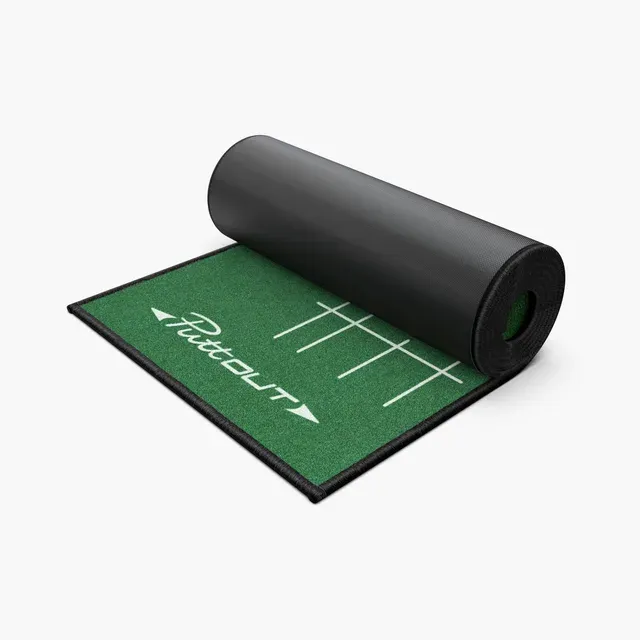
The short version
PuttOut's Large mat is the pick - a marked practice area in the mid-range tier. BirdieBall's foam green is the true-roll alternative in the premium tier. PrimePutt's turf mat justifies its premium price only for daily grinders. Skip the flagship-tier AirBreak Max - an inflatable break trainer is a different class of product at golf-simulator money.
Our picks at a glance
- PuttOut Large Putting Mat - Buy. The practice-area mat - printed distance and alignment lines, five targets, reads 10 on the stimp.
- BirdieBall 3' x 10' Standard Putting Mat - Buy. The foam green with grain, a choice of stimp speed and two drop-in cups.
- PrimePutt The Essential Mat - It depends. Dense nylon turf with a regulation cup and a walnut backstop, indoor or outdoor - 18 inches wide, 9 feet long.
- PuttOut AirBreak Max - Skip. An inflatable-base break trainer with a 10 ft dual-hole mat, battery ball returners and an app - a different class of product at flagship money.
The verdict in 30 seconds
What mattered most
- Surface
- Stimp speed (maker)
- Size
- Cups
- Use
- Price tier
A putting mat is the golfer gift that gets used in January - ten minutes a day on a true roll beats a bucket of range balls nobody hits. What separates the field is the surface: rolled carpet, aerated foam, or dense nylon turf decides whether the ball rolls like a green or a hallway. We compared PuttOut's large mat, BirdieBall's foam green, PrimePutt's turf mat and a flagship-tier inflatable break trainer, working from each maker's published specs and owner reports.
The practice-area mat - printed distance and alignment lines, five targets, reads 10 on the stimp.
Best for: The golfer who will actually practice - daily reps with alignment feedback built in.
- Sized for real work: PuttOut lists it at 367 x 67 cm (about 12 ft by 26 in), the largest mat in its range - a practice area, not a hallway strip.
- Printed distance markings up to 10 ft, alignment lines and five independent targets give every putt a reference - the feedback structure most mats leave out.
- Extra-thick TPR rubber backing; PuttOut says it rolls flat straight out of the cardboard cylinder it ships in, and a drawstring carry bag is included.
- Reads 10 on the stimp, per PuttOut - pair it with the brand's pressure trainer or putt to the printed targets.
- No cup in the surface - the targets are printed, or you add a separate trainer.
- A single fixed speed of 10 reads faster than many municipal greens.
Own the PuttOut Large Putting Mat? Tell us how it held up.
Thanks. Counted, and shown once enough owners have weighed in.
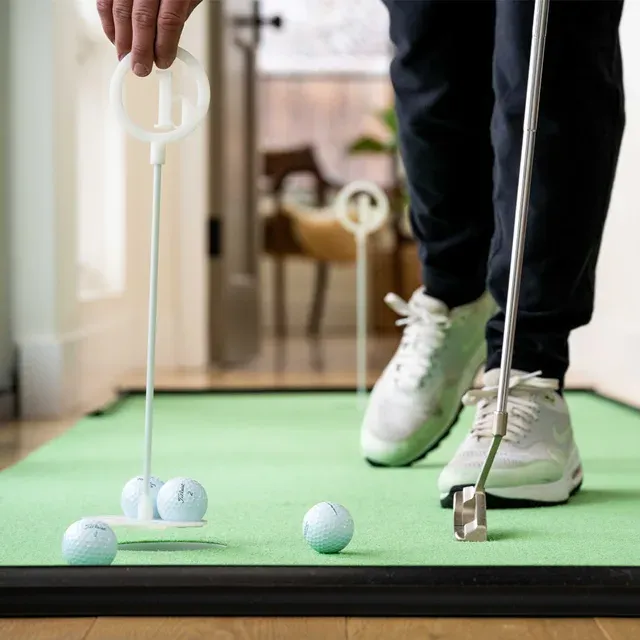
The foam green with grain, a choice of stimp speed and two drop-in cups.
Best for: The purist gift - for the golfer who wants the closest roll to a real green indoors.
- Real green physics: BirdieBall's patented aerated foam has grain, and the mat is bi-directional - one speed with the grain, another against it.
- Ordered in one of three speeds (Slow 9-10, Medium 10-11, Fast 11-13 stimp), so it can match the courses the golfer plays.
- Two holes cut into the half-inch foam, one foot from each end, with two standard cups, a high-back cup, two extraction flags, two rubber bumpers, hole plugs, a reducer insert and a deepening shim in the box.
- 3 by 10 feet of green that rolls up for storage and lays flat again, per the maker.
- Indoor-only - BirdieBall states it plainly; the foam is not for the deck.
- Premium tier, and it ships without a ball return; the ball stays in the cup until the flag lifts it out.
Own the BirdieBall 3' x 10' Standard Putting Mat? Tell us how it held up.
Thanks. Counted, and shown once enough owners have weighed in.
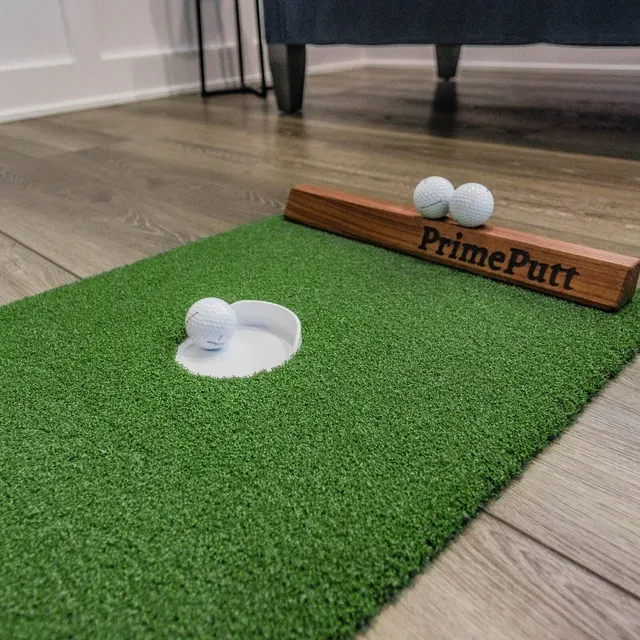
Dense nylon turf with a regulation cup and a walnut backstop, indoor or outdoor - 18 inches wide, 9 feet long.
Best for: The serious player's splurge gift - for someone who practices daily and wants course speed and a real cup.
- USA-made nylon turf with about half an inch of dense pile on a heavy rubber backing; PrimePutt states 10 on the stimp on a hard floor, 9 to 11 depending on the floor beneath.
- One regulation-width (4.25 in) cup set in a hole cut through the turf, plus a solid walnut backstop - a make here drops like a make on the course.
- Rated for indoor and outdoor use - the only mat here that can live on a patio.
- Distance markers at 3 and 6 feet; 10 lb; a 60-day money-back guarantee is published.
- Premium tier, roughly three times the PuttOut, for the committed only.
- At 1.5 feet wide you putt from beside the mat, not on it, and there is one cup, not two.
Own the PrimePutt The Essential Mat? Tell us how it held up.
Thanks. Counted, and shown once enough owners have weighed in.
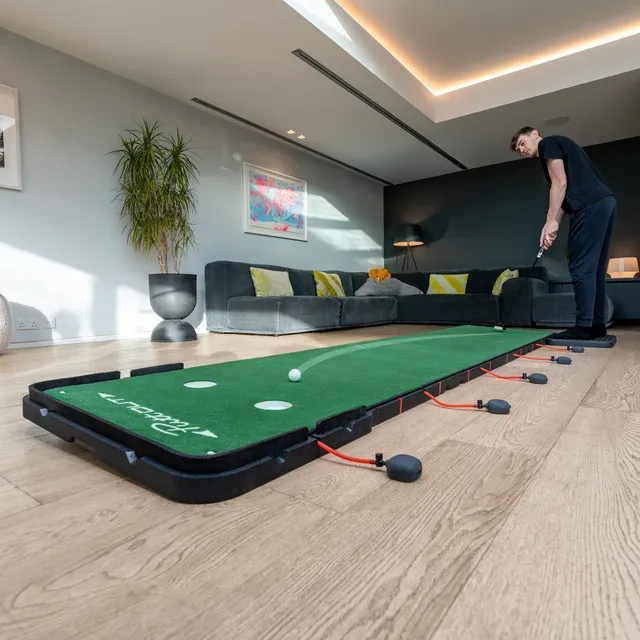
An inflatable-base break trainer with a 10 ft dual-hole mat, battery ball returners and an app - a different class of product at flagship money.
Best for: The teaching pro or simulator-room owner who will work through break scenarios - not the person being gifted a putting mat.
- The idea is clever: pumps and release valves raise and lower a flexible base under a 10 ft dual-hole mat to simulate breaking putts, with a Green Reading App to set specific breaks.
- Two 4.25 in holes sunk into the base for real lip-outs, battery-powered automatic ball returners (batteries included), a stand-on podium with risers and a retractable foam ball-stop.
- Longer and wider than the original AirBreak, ships fully assembled, and PuttOut says the rubber-backed mat runs at 10 on the stimp.
- Flagship-tier money - roughly six times the Large mat - buys the adjustable base, returners and app; the mat surface itself reads the same 10 on the stimp as the Large mat.
- Every new break means pumping and bleeding the base and matching it in the app - a setup chore that stands between you and a quick session.
- A foldable base with pumps, batteries and risers is a bigger thing to store than a rolled mat.
Own the PuttOut AirBreak Max? Tell us how it held up.
Thanks. Counted, and shown once enough owners have weighed in.
| Criteria | Large Putting Mat Top pick Buy it Buy | 3' x 10' Standard Putting Mat Buy it Buy | The Essential Mat It depends Buy | AirBreak Max Skip it Buy |
|---|---|---|---|---|
| Best for | The golfer who will actually practice - daily reps with alignment feedback built in. | The purist gift - for the golfer who wants the closest roll to a real green indoors. | The serious player's splurge gift - for someone who practices daily and wants course speed and a real cup. | The teaching pro or simulator-room owner who will work through break scenarios - not the person being gifted a putting mat. |
| Price tier | $$ · mid-range | $$$ · premium | $$$ · premium | $$$$ · flagship |
| Surface | Carpet-style, printed lines, TPR backing | Aerated foam with grain, half-inch deep | Dense nylon turf, rubber backing | Rubber-backed mat on inflatable base |
| Stimp speed (maker) | 10 | Choice of 9-10, 10-11 or 11-13 | 10 on hard floor; 9-11 by floor | 10 (mat); break adjustable |
| Size | 367 x 67 cm (about 12 ft x 26 in) | 3 x 10 ft | 1.5 x 9 ft | 10 ft, dual-hole |
| Cups | None (printed targets) | 2 drop-in cups | 1 regulation cup | 2 holes, 4.25 in |
| Use | Indoor, rolls up | Indoor only | Indoor + outdoor | Indoor, needs inflating |
| Price tier | $$ · mid-range | $$$ · premium | $$$ · premium | $$$$ · flagship |
Which one is right for you?
- The golfer who will actually practice - daily reps with alignment feedback built in. Buy it PuttOut Large Putting Mat
- The purist gift - for the golfer who wants the closest roll to a real green indoors. Buy it BirdieBall 3' x 10' Standard Putting Mat
- The serious player's splurge gift - for someone who practices daily and wants course speed and a real cup. It depends PrimePutt The Essential Mat
- The teaching pro or simulator-room owner who will work through break scenarios - not the person being gifted a putting mat. Skip it PuttOut AirBreak Max
How we judged the field
A putting mat is judged on one thing above all: whether the ball rolls like it does on grass. Surface technology is the divider - carpet-style mats, aerated foam and dense turf each behave differently under the putter - and everything else (size, markings, gimmicks) is secondary. We ranked the field on roll truth, practice value, size and price tier, using each maker’s published specifications and the pattern of owner reports. We do not test products; where a maker does not publish a figure, we say so.
PuttOut Large Putting Mat
Buy itThe PuttOut Large is the working golfer’s mat: a real practice area, listed by PuttOut at 367 x 67 cm (about 12 ft by 26 in), printed with distance markings up to 10 ft, alignment lines and five independent targets that turn every putt into a rep with a reference. It has an extra-thick TPR rubber backing and ships in a dense cardboard cylinder; PuttOut says it rolls flat straight out of the tube, and a drawstring carry bag is included for packing it away, which matters in a shared house.
The surface is carpet-style and reads a stated 10 on the stimp: fast, true, unforgiving of a wobbly face. There is no cup in the surface - the printed targets are the hole, or pair it with the brand’s pressure trainer. In the mid-range tier it hits the value peak: enough mat to improve on, priced so the gift does not need a justification memo.
BirdieBall 3’ x 10’ Standard Putting Mat
Buy itBirdieBall builds a putting green out of patented aerated foam, half an inch deep, and the physics show it: the surface has grain, takes the ball’s speed like turf, and is bi-directional, so putts run at one speed with the grain and another against it. You order the speed - Slow (9-10), Medium (10-11) or Fast (11-13 on the stimp) - to match the courses the golfer plays. Two holes are cut one foot from each end, and the box holds two standard cups, a high-back cup for firm putts, two 15 in extraction flags, two rubber bumpers, two hole plugs, a reducer insert and a deepening shim. BirdieBall puts assembly at five to ten minutes.
The trade-offs are clear ones. Foam means indoor use only - BirdieBall states it in capitals - and there is no ball return; the flag lifts the ball out. In the premium tier it costs more than the PuttOut; what it buys is the closest indoor roll to a real green anywhere in this field.
PrimePutt The Essential Mat
It dependsPrimePutt’s Essential is the premium tier made real: USA-made nylon turf with about half an inch of dense pile on a heavy rubber backing, stated at 10 on the stimp on a hard floor or low-pile carpet and 9 to 11 depending on the floor beneath. One regulation-width (4.25 in) cup sits in a hole cut through the turf, with a solid walnut backstop behind it and distance markers at 3 and 6 feet. It is the only mat here rated for both indoor and outdoor use, it weighs 10 lb, and PrimePutt publishes a 60-day money-back guarantee.
The dependency is the golfer: at roughly three times the PuttOut, this is for someone who practices daily and can tell a 10 stimp from an 8 by feel. It is also narrow - 18 inches wide and 9 feet long, with a single cup - so you putt from beside it rather than standing on it. For the occasional putter, a mid-range mat plus a pressure trainer delivers most of the training at a third of the price.
PuttOut AirBreak Max
Skip itThe AirBreak Max is a different class of product: a break trainer, not a mat. Pumps and release valves raise and lower a flexible base under a 10 ft dual-hole mat, and PuttOut’s Green Reading App sets specific breaks. Two 4.25 in holes are sunk into the base for real lip-outs, battery-powered ball returners send made putts back (batteries included), and a stand-on podium with risers keeps you level with whatever slope you have built. It ships fully assembled, folds away, and the rubber-backed mat runs at a stated 10 on the stimp.
Why skip it as a gift: the flagship price - roughly six times the Large mat - buys the adjustable base, the returners and the app, while the putting surface itself reads the same 10 as the Large mat. Every new break means pumping, bleeding valves and matching the app, a routine that stands between you and a quick session, and the folded base with its pumps and batteries is a bigger thing to store than a rolled mat. A clever training aid for a teaching room; the wrong gift for a golfer who wants to putt.
Sources
Specs in this review come from these pages.
PuttOut Large vs BirdieBall Standard: which should you buy?
Buy the PuttOut if the goal is structured practice - alignment lines, five targets, roll-flat convenience, and a price tier that leaves room for the pressure trainer. Buy the BirdieBall if the goal is realism - foam with grain, a choice of stimp speed and cups that hold the ball, for the purist who wants a green in the living room. Feedback versus fidelity.
What to look for
Surface technology first: carpet-style for value and flatness, foam for green-like grain, dense turf for course speed and outdoor use - each trades price against realism. Stimp speed matters more than marketing: 9 to 11 is real green pace, and only BirdieBall lets you choose. Length decides what you can practice; nine to ten feet covers the useful distances. Check the width, which decides whether you stand on the mat or beside it, and whether the maker says it lies flat after storage - a curled mat teaches bad reads.
Our final take
PuttOut’s Large mat is the pick - the best practice value in the mid-range tier, marked for real training. BirdieBall’s foam green is the true-roll alternative for the purist in the premium tier. PrimePutt’s turf mat earns its premium price only for the daily grinder. And skip the AirBreak Max - a flagship-tier break trainer is a different product from a putting mat, and a coin under the PuttOut teaches the same lesson.
Questions, answered
Do putting mats roll true?
Depends on the surface. Carpet-style mats like PuttOut roll flat and read 10 on the stimp; foam greens like BirdieBall simulate real grain and break; dense turf like PrimePutt reads 9-11 depending on the floor. Cheap mats ship rolled and keep a curl - all three makers here say their mats lie flat.
Printed lines or holes - what matters more?
Feedback beats a cup. Printed alignment and distance markings (PuttOut) turn random rolls into practice. A real cup (BirdieBall, PrimePutt) gives the satisfying drop; a pressure trainer is the best small add-on either way.
How much space do you actually need?
Nine to ten feet of length covers the most useful practice distances - anything shorter trains only the knee-knockers. Width decides whether you stand on the mat (PuttOut at 26 in, BirdieBall at 3 ft) or beside it (PrimePutt at 18 in).
Are break-adjustable mats worth it?
For a coach or a sim room, adjustable breaks add real training value. For everyone else, they are an inflatable base you will set up once - the flagship price buys technology that a coin under a cheaper mat approximates.
Indoor or outdoor - can a mat do both?
Most cannot - BirdieBall's foam is indoor-only. PrimePutt's turf is the exception, rated for both, which is part of its premium. Plan for indoor use and a rolled-up storage spot.
Deciding between the top two? See our head-to-head: PuttOut Large Putting Mat vs BirdieBall 3' x 10' Standard Putting Mat.
More in Outdoors & Fitness
PuttOut Large Putting Mat vs BirdieBall 3' x 10' Standard Putting Mat Head-to-head →  The Best Rain Boots: 4 Compared (and One to Skip)
 The Best Rain Jackets: 4 Compared (and One to Skip)
 The Best Rechargeable Hand Warmers: 6 Compared (and One to Skip)
 The Best Robotic Pool Cleaners: 4 Compared (and One to Skip)
 Best Running Shoes for Beginners: Daily Trainers Compared