

Outdoors & Fitness
The Best Hammock Straps: 4 Compared (and One to Skip)
Two of these four publish a weight capacity. The other two publish loop counts and lengths and leave the number that decides whether you hit the ground unstated.
The short version
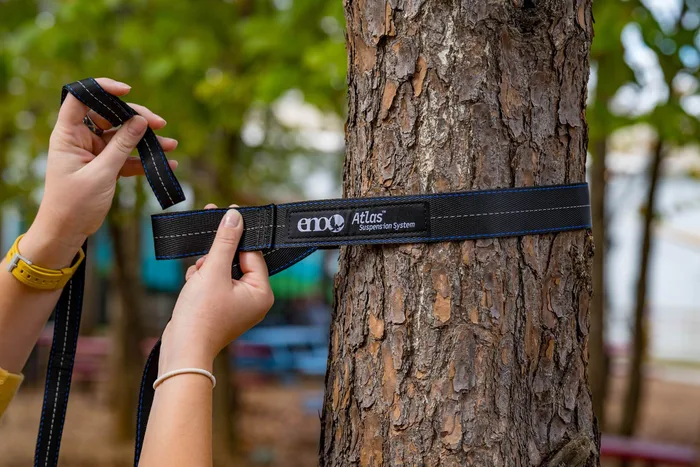
The ENO Atlas is the pick for most people: a stated 400 lb capacity in 1000D polyfilament webbing, 9 feet per strap with 15 attachment points, and a width that tapers from 1.5 inches down to 0.75 to spread load on the bark. The Kammok Python 10 UL is the one to take if you carry the straps rather than leave them in a car, because Kammok states 3 ounces and a 300 lb capacity, with a variable width design that widens at the tree end. The Wise Owl Talon XL suits a specific buyer: 10 feet per strap, 38 connection loops and triple stitching at each tension point, though Wise Owl publishes no capacity. Skip the Grand Trunk Trunk Straps for most people, because they publish neither a capacity nor a weight while offering nothing the others do not. Best for: anyone who would rather read a capacity than assume one.
Our picks at a glance
- ENO Atlas Hammock Straps - Buy. The highest published capacity here at 400 lb, on a daisy chain with 15 attachment points and a width that tapers toward the hammock end.
- Kammok Python 10 UL - Buy. Three ounces for a stated 300 lb capacity, using a woven construction that removes the stitching bulk from the loops.
- Wise Owl Outfitters Talon XL Hammock Tree Straps - It depends. The most adjustment points here and the widest tree contact, from a maker that documents the stitching carefully and never states a capacity.
- Grand Trunk Trunk Straps - Skip. A competent pair of 10 foot webbing straps that publish neither a capacity nor a weight, in a field where half the entrants publish both.
The verdict in 30 seconds
What mattered most
- Published weight capacity
- Published strap weight
- Stated length per strap
- Stated width
- Attachment points
- Material named
Hammock straps are the part of a hammock system nobody researches and everybody trusts. They hold your entire weight a couple of feet off the ground, usually with a shock load every time you get in, and the specification that covers that is a stated weight capacity. Half of this field publishes one. The other half publishes the number of adjustment loops, which is a convenience feature, and says nothing about load at all. We compared four brands on what each is willing to put in writing.
The highest published capacity here at 400 lb, on a daisy chain with 15 attachment points and a width that tapers toward the hammock end.
Best for: General hammock use where the straps travel by car and you want the highest published capacity.
- ENO states a capacity of 400 lbs, or 181 kg, which is the highest figure published in this comparison.
- 1000D polyfilament webbing, a named material rather than a generic description.
- Stated dimensions of 9 feet by 1.5 inches tapering to 0.75 inches, so the wide end sits against the bark and the narrow end carries the carabiner.
- 15 attachment points per strap in a daisy chain, which is enough to fine-tune a hang without sliding anything.
- An XL version exists in the same line at 13 feet, for trees that are further apart than you planned.
- Heavier than the ultralight options, which matters if the straps live in a pack.
- Polyfilament webbing holds water and takes a while to dry once it has been rained on.
- The 9 foot length is short for wide-spaced trees, which is why the XL exists.
- No stated breaking strength, only a working capacity.
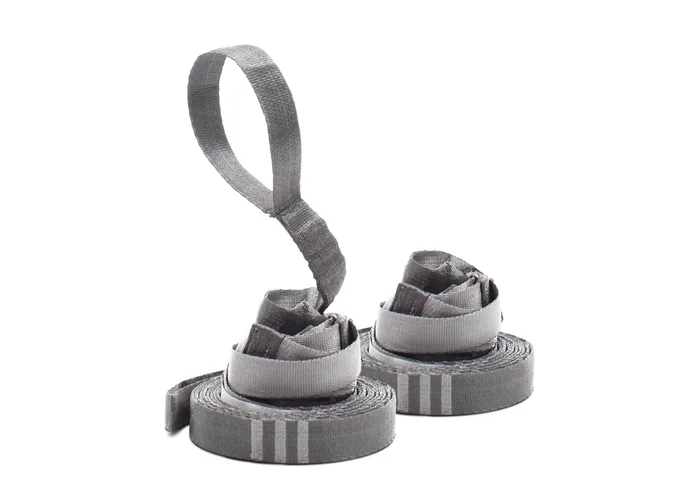
Three ounces for a stated 300 lb capacity, using a woven construction that removes the stitching bulk from the loops.
Best for: Backpackers and bikepackers carrying the suspension rather than driving it to the trailhead.
- Kammok states 3 ounces and a capacity of 300 lb, so both halves of the weight question are answered.
- The Nanoweave construction eliminates extra stitching and bulk, which is where a conventional daisy chain adds both.
- Woven with Spiraline, which Kammok describes as a technical fibre 15 times stronger than steel by weight.
- A variable width design that widens at the end of each strap, putting the broad section against the tree.
- Packs into its own Sil/PU coated stuff sack, so the straps stay dry in a pack.
- Most expensive straps here by a clear margin.
- 300 lb is below the ENO figure, which matters for heavier users or a two-person hammock.
- Thin webbing is less comfortable to handle and tension than a wide flat strap.
- The strength claim is expressed as a comparison to steel rather than as a breaking strength in pounds.

The most adjustment points here and the widest tree contact, from a maker that documents the stitching carefully and never states a capacity.
Best for: Car camping and backyard use where the extra length and adjustment matter more than a published load rating.
- 38 connection loops, 19 on each strap, which is more adjustment than anything else in this comparison.
- Stated dimensions of 10 feet by 1 inch per strap, longer than the standard ENO Atlas.
- Triple stitched at each connection and tension point, which Wise Owl calls out specifically.
- Extra-wide coverage designed to spread load on the bark, and the cheapest option here.
- No weight capacity published anywhere on the product page.
- No strap weight published either, so it cannot be compared against the 3 ounce figure from Kammok.
- Nylon ripstop is named as the material but no denier is given.
- More loops than most people will ever use, at the cost of more stitching to inspect.

A competent pair of 10 foot webbing straps that publish neither a capacity nor a weight, in a field where half the entrants publish both.
Best for: An occasional backyard hang where the load is well inside anything a 1 inch webbing strap would worry about.
- 36 adjustment points, 18 on each side, which is ample for dialling in a hang.
- 10 feet per strap, giving 20 feet of total span to work with.
- 1 inch webbing that Grand Trunk describes as tree-friendly, and compatible with almost any hammock.
- Grand Trunk suggests other anchor points such as a vehicle roof rack, which is a fair use case.
- No weight capacity published, which is the specification the whole category exists around.
- No strap weight published either.
- No material or denier stated beyond the width of the webbing.
- Offers nothing the better-documented straps here do not, at a similar price to the Wise Owl.
| Criteria | Atlas Hammock Straps | Python 10 UL | Talon XL Hammock Tree Straps | Trunk Straps |
|---|---|---|---|---|
| Verdict | Buy it | Buy it | It depends | Skip it |
| Best for | General hammock use where the straps travel by car and you want the highest published capacity. | Backpackers and bikepackers carrying the suspension rather than driving it to the trailhead. | Car camping and backyard use where the extra length and adjustment matter more than a published load rating. | An occasional backyard hang where the load is well inside anything a 1 inch webbing strap would worry about. |
| Price tier | $$ · mid-range | $$$ · premium | $ · budget | $ · budget |
| Published weight capacity | 400 lb (181 kg) | 300 lb | Not published | Not published |
| Published strap weight | Not published for the standard; XL stated at 13 oz | 3 oz | Not published | Not published |
| Stated length per strap | 9 ft | Not published for the 10 UL | 10 ft | 10 ft |
| Stated width | 1.5 in tapering to 0.75 in | Variable, widening at the tree end | 1 in | 1 in |
| Attachment points | 15 per strap | Not published | 19 per strap, 38 total | 18 per side, 36 total |
| Material named | 1000D polyfilament webbing | Spiraline fibre, Nanoweave construction | Nylon ripstop, no denier given | Not published |
| Tree protection approach | Width tapers so the wide end meets the bark | Variable width, widening at each end | Extra-wide coverage | Described as tree-friendly |
| Longer option in the same line | Atlas XL at 13 ft | Python 15 and Python Extenders | Not stated | Not stated |
Which one is right for you?
- General hammock use where the straps travel by car and you want the highest published capacity. Buy it ENO Atlas Hammock Straps
- Backpackers and bikepackers carrying the suspension rather than driving it to the trailhead. Buy it Kammok Python 10 UL
- Car camping and backyard use where the extra length and adjustment matter more than a published load rating. It depends Wise Owl Outfitters Talon XL Hammock Tree Straps
- An occasional backyard hang where the load is well inside anything a 1 inch webbing strap would worry about. Skip it Grand Trunk Trunk Straps
How we judged the field
Five things decide a hammock strap and only one of them is about convenience. The first is published weight capacity, because the straps are the part of the system that fails toward the ground and because the load in them is higher than your body weight once the hang angle is taken into account. The second is strap weight, which decides whether the suspension is something you carry or something that lives in a car boot. The third is length, since the most common disappointment in this category is arriving somewhere the trees are further apart than your straps reach. The fourth is width at the tree, which is both a bark question and a rules question at managed sites. The fifth is the number of attachment points, which is the feature the packaging leads on and the least important of the five.
The field splits on the first of those, and the split is stark. ENO publishes 400 lb and Kammok publishes 300 lb, both on the product page, alongside named materials: 1000D polyfilament webbing in one case, a Spiraline fibre in a Nanoweave construction in the other. Wise Owl and Grand Trunk publish loop counts, lengths and widths in careful detail and no capacity at all, and neither publishes a strap weight either. So we took two from each side. It is worth saying plainly that an unstated capacity is not evidence of a weak strap. It is evidence that you are being asked to take the most safety-relevant property on trust, in a category where two competitors decided not to ask that.
ENO Atlas Hammock Straps - buy
The Atlas is the strap we would put under most hammocks, and the case for it is a number. ENO states a capacity of 400 lbs or 181 kg, the highest published figure in this comparison, in 1000D polyfilament webbing. The dimensions are stated too: 9 feet long, 1.5 inches wide tapering to 0.75, which is a deliberate piece of design rather than a manufacturing convenience. The wide section is the part that goes around the trunk, spreading the load on the bark, and the narrow end is the part your carabiner clips into, where width would only add bulk. Fifteen attachment points per strap is enough adjustment that you will never wish for more. The limits are practical. It is heavier than the ultralight options, polyfilament holds water and dries slowly, and 9 feet runs out on wide-spaced trees, which is precisely why ENO sells the Atlas XL at 13 feet. If the straps live in a car, none of that matters much.
Kammok Python 10 UL - buy
The Python 10 UL is the one to buy if you are carrying the suspension. Kammok states 3 ounces and a 300 lb capacity, which is the combination that makes it interesting: plenty of straps are light and plenty state a capacity, and rather fewer do both. The construction is the argument. Kammok’s Nanoweave approach removes the extra stitching and bulk that a conventional sewn daisy chain needs, and the webbing is woven with Spiraline, which the company describes as a technical fibre fifteen times stronger than steel for its weight. The variable width design widens at the end of each strap so the broad part meets the bark, the same reasoning as the ENO taper arrived at from the other direction. It packs into a coated stuff sack. The costs are price, which is the highest here, and a capacity 100 lb below the Atlas, which is worth attention for heavier users or anyone hanging a two-person hammock.
Wise Owl Outfitters Talon XL Hammock Tree Straps - it depends
The Talon XL is the most thoroughly described strap here on everything except the thing that matters most. Wise Owl states 10 feet by 1 inch per strap, 38 connection loops split 19 a side, triple stitching at each connection and tension point, and extra-wide coverage for the bark. That is more detail than most budget brands offer, and the triple stitching call-out is a direct response to where daisy chains actually wear. It is also the cheapest option in this comparison and the longest standard strap, which solves the wide-tree problem the ENO Atlas has. What it does not have is a published weight capacity, or a published strap weight. For a backyard or car-camping hang, with an adult well inside any sensible margin, that is a gap you can live with knowingly. For anything closer to the limit, you are guessing, and the point of this review is that you do not have to guess with two of the other three.
Grand Trunk Trunk Straps - skip
The Trunk Straps are perfectly reasonable and we would still buy something else. Grand Trunk publishes 36 adjustment points across two 10 foot straps, 1 inch webbing, and compatibility with almost any hammock, plus the sensible observation that a vehicle roof rack works as an anchor. What is missing is everything load-related: no capacity, no strap weight, and no material beyond the width of the webbing. Set against the Wise Owl Talon XL, which is a similar price and a similar shape, the Grand Trunk gives you two fewer adjustment points, no stated material, and the same absent capacity, while the Wise Owl at least names nylon ripstop and calls out its stitching. Set against the ENO Atlas it gives up a published 400 lb rating. There is nothing wrong with these straps. There is simply no question to which they are the best answer.
ENO Atlas Hammock Straps vs Kammok Python 10 UL: which should you buy?
The Atlas and the Python 10 UL are the two to choose between, and the deciding question is whether you carry the straps. If they live in a car, the ENO is the straightforward pick: 400 lb published, 1000D polyfilament webbing, and a 1.5 inch section against the bark that is both kinder to the tree and more likely to satisfy a site that specifies a minimum strap width. Fifteen attachment points is all the adjustment anybody needs and the whole thing is considerably cheaper than the Kammok.
If the straps go in a pack, the Python 10 UL changes the maths. Three ounces against a conventional webbing pair is a real saving on a trip where you are also carrying the hammock, and Kammok is one of only two brands here that tells you both the weight and the capacity. The trade is 300 lb against 400, a higher price, and thin webbing that is less pleasant to handle when you are tensioning it. Buy the ENO for capacity, durability and value. Buy the Kammok when the grams are the point and 300 lb is comfortably above your loaded weight.
What to look for
- Find the published capacity first: it is a safety-relevant figure and only some makers state one, with 400 lb and 300 lb the two numbers published here.
- Remember the hang angle multiplies the load: a flatter hang puts more tension in each strap than your body weight alone.
- Check the total length against real trees: 9 feet is standard and runs out often enough that makers sell 13 foot versions and extenders.
- Look at width at the tree end: an inch is the common minimum at managed sites, and tapering or variable-width designs put the wide part on the bark.
- Treat loop count as a convenience feature: beyond about a dozen per strap the increments are smaller than you can feel.
- Inspect the stitching, not the webbing: daisy chains fail at the sewn loops, which is why triple stitching at tension points is worth calling out.
Our final take
This is a category where the marketing leads on the least important number. Loop counts are printed large and capacities are printed by half the field, which is the wrong way round for a part that holds a person off the ground. ENO’s Atlas is the sensible default because it states 400 lb, names its webbing and shapes its width around the tree. Kammok’s Python 10 UL is the answer when you carry the straps, and it is the only other one here that tells you both what it weighs and what it holds. The two budget pairs are probably fine, and probably is doing a lot of work in that sentence.
Questions, answered
How much weight do hammock straps actually need to hold?
More than you weigh, because of how you get in. Sitting down into a hammock applies a shock load well above your static weight, and the angle of the suspension multiplies the tension in the straps: the flatter the hang, the higher the force at each end. A rule of thumb is that a shallow hang can put roughly one and a half times your body weight into each strap. That is why a published capacity matters, and why ENO's 400 lb and Kammok's 300 lb are worth reading before you assume any strap is fine.
Why do some brands publish a capacity and others do not?
There is no mandatory standard for hammock suspension, so a capacity figure is voluntary. ENO states 400 lb and Kammok states 300 lb. Wise Owl and Grand Trunk both describe their straps in detail, giving lengths, widths and loop counts, and neither states a load rating anywhere on the page. That does not make those straps weak, and plenty of people use them without incident. It does mean you are being asked to judge a safety-relevant part on adjectives, which is a different proposition from judging it on a number.
What makes a strap tree-friendly?
Width, mostly. A narrow line cuts into bark and can girdle a tree over repeated use, which is why many parks require straps at least an inch wide and ban rope suspension. All four straps here are an inch or wider at the tree, and two go further: ENO tapers the Atlas from 1.5 inches at the tree end down to 0.75, and Kammok widens the Python at each end for the same reason. Wider contact spreads the pressure, and it is worth checking local rules, because some sites specify a minimum strap width.
How many adjustment loops do I need?
Fewer than the marketing suggests. Loop count decides how finely you can tune the hang, and beyond about a dozen per strap the increments are smaller than you can feel. ENO gives 15 per strap, Wise Owl gives 19 and Grand Trunk 18. What matters more is total length, because the common failure is arriving at a site where the trees are further apart than your straps reach. That is why ENO sells a 13 foot XL and Kammok sells extenders.
Do straps wear out, and how would I tell?
They do, mainly from ultraviolet light and abrasion rather than from load. Webbing left on a porch all summer degrades, and the fibres that hold a daisy chain together are the stitching at each loop. Inspect the stitching at the tension points before each season, look for fuzzing or broken threads at the loops you use most, and check the webbing where it passes over bark for cuts. Wise Owl calling out triple stitching at each connection point is a response to exactly this wear pattern.
Deciding between the top two? See our head-to-head: ENO Atlas Hammock Straps vs Kammok Python 10 UL.
More Outdoors & Fitness reviews
 The Best Handlebar Tape: 4 Compared (and One to Skip)
  The Best Headlamps of 2026: Honest Picks for Trail, Camp, and Everyday
  The Best Heart Rate Monitors: 4 Compared (and One to Skip)
  The Best Hiking Boots of 2026
  The Best Hiking Daypacks: 4 Compared (and One to Skip)
  The Best Hydration Bladders: 4 Compared (and One to Skip)