

Outdoors & Fitness
The Best Bike Lights: 4 Compared (and One to Skip)
Every one of these headlines a lumen figure and a runtime figure that are never true at the same time. At maximum output one of them lasts 55 minutes.

The short version
The Knog Blinder 1400 is the pick: 1400 lumens, an IP67 rating that covers dust as well as immersion, 180 grams, and a full mode table that states 1.5 hours at maximum without burying it. The Magicshine RAY 1600B is the value choice and the brightest here at 1600 lumens with 2 hours 12 minutes at that output, the longest max-output runtime in the comparison. The NiteRider Lumina 1200 Boost is the lightest at 172 grams and publishes its modes honestly, including the part where maximum lasts 55 minutes. Skip the Lezyne Macro Drive 1400+: it headlines 1400 lumens and a 300-hour maximum runtime in a flashing mode, and never publishes the runtime at full output at all. Find the runtime at max before anything else. Best for: anyone who has had a light die halfway home.
Our picks at a glance
- Knog Blinder 1400 Front Bike Light - Buy. A complete mode table, an IP67 rating and 180 grams, with 1.5 hours at maximum stated plainly.
- Magicshine RAY 1600B Dual-LED Bike Light - Buy. Brightest here and the longest runtime at full output, at 2 hours 12 minutes.
- NiteRider Lumina 1200 Boost Bike Headlight - It depends. The lightest here at 172 grams, and honest that maximum output lasts 55 minutes.
- Lezyne Macro Drive 1400+ Front - Skip. Headlines 1400 lumens and 300 hours, and never says how long 1400 lumens lasts.
The verdict in 30 seconds
What mattered most
- Max output
- Runtime at max output
- Headline runtime figure
- Full mode table published
- Weight
- Battery
A front bike light is sold on two numbers, and they come from different modes. The lumen figure is the maximum. The runtime figure is usually the minimum output, a flashing mode measured in days. Put them side by side on a product page and you get a light that appears to do 1400 lumens for 120 hours. We compared four and went looking for the number that actually matters, which is how long the light runs at the brightness you bought it for.
A complete mode table, an IP67 rating and 180 grams, with 1.5 hours at maximum stated plainly.
Best for: All-road and gravel riders who want the runtime table published rather than reconstructed.
- Publishes output and runtime together for all six modes: 1400 lumens for 1.5 hours, 650 for 3, 230 for 8, down to 150 lumens on Eco Flash for 120.
- IP67, the only rating here that covers dust ingress as well as temporary immersion.
- 180 grams with a 5000 mAh cell, and dual mount options included rather than sold separately.
- Precision beam optics stated for a defined 120 metre throw, so the beam has a described shape rather than a raw output number.
- 1.5 hours at maximum is short for a long winter commute, so you are riding in a lower mode most of the time.
- 5 hour charge time is the longest in this comparison.
- 1400 lumens is second to the Magicshine on paper.
- No published beam cutoff, so it will dazzle oncoming riders if aimed carelessly.

Brightest here and the longest runtime at full output, at 2 hours 12 minutes.
Best for: Riders who genuinely use maximum output and want it to last more than an hour.
- 1600 lumens, the highest output in the comparison, with a stated 140 metre throw from dual LEDs.
- 2 hours 12 minutes at full 1600 lumens, which is roughly 50 percent longer at max than the Knog and more than double the NiteRider.
- Publishes a full mode table from 200 lumens for 20 hours up to 1600 for 2:12, including hybrid and flash modes.
- 5200 mAh battery at 190 grams, and USB-C charging.
- IPX6 is the weakest water rating here and carries no dust rating at all.
- Dual-LED round beam throws light upward as well as forward, which is antisocial on shared paths.
- The headline 20-hour runtime is the 200 lumen low mode, which is a tenth of the advertised brightness.
- Heavier than the NiteRider and the Knog for the extra output.

The lightest here at 172 grams, and honest that maximum output lasts 55 minutes.
Best for: Commuters who ride mostly in medium modes and want the lightest head unit on the bar.
- 172 grams, the lightest light in this comparison.
- Publishes every mode with its output and runtime, including Boost at 1200 lumens for 55 minutes.
- Seven modes with a usable spread from 75 lumens up to 1200, so the light adapts to conditions rather than offering bright and off.
- Travel Lock Out mode prevents the light switching on in a bag, which is a real cause of arriving with a flat light.
- 55 minutes at maximum is by far the shortest here, so Boost is a burst mode rather than a riding mode.
- 1200 lumens is the lowest maximum output in the comparison.
- IP66 covers dust and jets but not immersion, so a deep puddle is a risk.
- Charge times of 3 to 6 hours depending on the charger used.
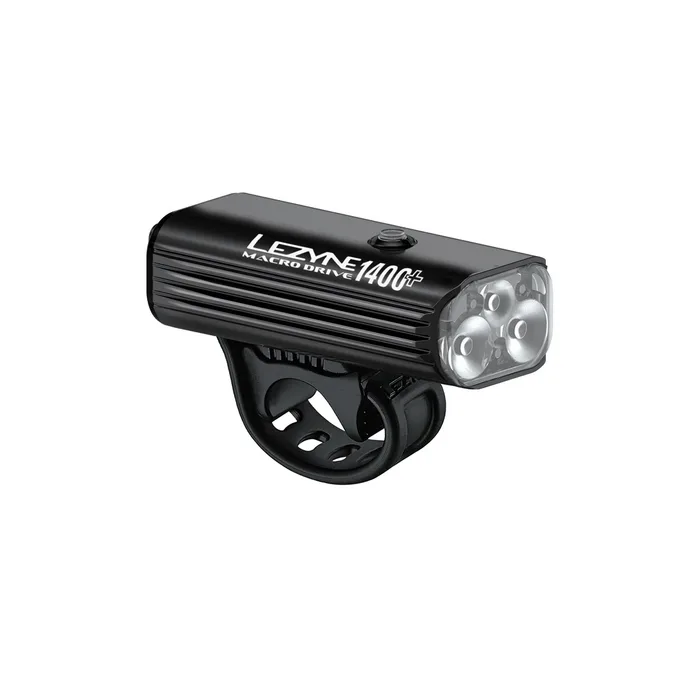
Headlines 1400 lumens and 300 hours, and never says how long 1400 lumens lasts.
Best for: Hard to say, because the one number you would plan a night ride around is the one that is missing.
- CNC-machined aluminium body with cooling fins, the most durable-feeling construction here and better at shedding heat at high output.
- IPX7 water rating, which covers temporary immersion.
- Tri-Focus Optics give a brighter centre spot inside a wide pattern, which is a described beam shape rather than a bare number.
- Waterproof USB-C 2A fast charging and compatibility with an external power pack for long rides.
- Publishes seven light modes and a single Max Runtime of 300 hours, with no runtime stated for the 1400 lumen setting anywhere on the page.
- That 300-hour figure is Femto mode, a minimal flash, so the two headline numbers describe opposite ends of the light.
- 230 grams, the heaviest here by 40 grams.
- No published mode table, so you cannot plan a ride around it without buying it first.
| Criteria | Blinder 1400 Front Bike Light | RAY 1600B Dual-LED Bike Light | Lumina 1200 Boost Bike Headlight | Macro Drive 1400+ Front |
|---|---|---|---|---|
| Verdict | Buy it | Buy it | It depends | Skip it |
| Best for | All-road and gravel riders who want the runtime table published rather than reconstructed. | Riders who genuinely use maximum output and want it to last more than an hour. | Commuters who ride mostly in medium modes and want the lightest head unit on the bar. | Hard to say, because the one number you would plan a night ride around is the one that is missing. |
| Price tier | $$ · mid-range | $$ · mid-range | $$ · mid-range | $$ · mid-range |
| Max output | 1400 lumens | 1600 lumens | 1200 lumens | 1400 lumens |
| Runtime at max output | 1.5 hours | 2 hours 12 minutes | 55 minutes | Not published |
| Headline runtime figure | 120 hours, Eco Flash at 150 lm | 20 hours, Low at 200 lm | Varies by mode, all published | 300 hours, Femto mode |
| Full mode table published | Yes, all six | Yes, all modes | Yes, all seven | No |
| Weight | 180 g | 190 g | 172 g | 230 g |
| Battery | 5000 mAh | 5200 mAh | Not published | 5200 mAh |
| Ingress rating | IP67 | IPX6 | IP66 | IPX7 |
| Stated throw | 120 m | 140 m | Not published | Not published |
| Charge time | 5 hours | Not published | 3 to 6 hours | Not published |
Which one is right for you?
- All-road and gravel riders who want the runtime table published rather than reconstructed. Buy it Knog Blinder 1400 Front Bike Light
- Riders who genuinely use maximum output and want it to last more than an hour. Buy it Magicshine RAY 1600B Dual-LED Bike Light
- Commuters who ride mostly in medium modes and want the lightest head unit on the bar. It depends NiteRider Lumina 1200 Boost Bike Headlight
- Hard to say, because the one number you would plan a night ride around is the one that is missing. Skip it Lezyne Macro Drive 1400+ Front
How we judged the field
Five things decide a front bike light, and the first one is almost never on the front of the box. Runtime at maximum output is what tells you whether the light covers the dark part of your ride, and it is a different number from the runtime the brand advertises. The advertised figure is usually the lowest flashing mode, which can be fifty times longer. Second is the maximum output itself, which matters less than people think once you are above roughly 600 lumens on unlit roads. Third is the ingress rating, where the difference between IP67 and IPX6 is a dust rating nobody mentions. Fourth is weight, since this hangs off a handlebar and the spread here is 172 to 230 grams. Fifth is beam shape, because a round beam from a bright LED puts a lot of its output into the eyes of oncoming riders.
What separated the field was disclosure rather than hardware. Three of these four publish a complete mode table, pairing each output with its runtime, which lets you plan a ride. The fourth publishes seven modes, a single maximum runtime of 300 hours, and no runtime for its headline brightness at all. We picked these four because they sit in the same 1200 to 1600 lumen class with similar batteries, which makes the differences in what they tell you stand out more clearly than the differences in what they do.
Knog Blinder 1400 Front Bike Light - buy
The Knog Blinder 1400 wins this comparison on honesty and on an ingress rating nobody else matches. Its mode table is complete and specific: 1400 lumens for 1.5 hours, 650 for 3, 230 for 8, a strobe at 230 for 8, and Eco Flash at 150 lumens for 120 hours. That last figure is the one Knog could have put on the front of the box next to 1400 lumens, and the fact that the table sits there intact means you can plan a ride from it. The IP67 rating is the only one here covering dust as well as immersion, which matters on gravel and through winter salt. At 180 grams with a 5000 mAh cell and both mounts included, it is a complete product rather than a head unit plus accessories. The costs are real: 1.5 hours at maximum is short for a long winter commute, the 5 hour charge is the slowest here, and like everything in this group it has no beam cutoff, so a carelessly aimed Blinder will dazzle people coming the other way.
Magicshine RAY 1600B Dual-LED Bike Light - buy
The Magicshine RAY 1600B is the light to buy if you actually ride at maximum. Its 1600 lumens is the highest output here, and more importantly it holds that output for 2 hours 12 minutes, which is roughly 50 percent longer than the Knog manages at 1400 and more than double the NiteRider at 1200. For a rider doing a genuinely dark two-hour loop, that single figure settles the comparison. Magicshine publishes the full table, from 200 lumens for 20 hours through 400 for 8:30 and 800 for 4:00, and states a 140 metre throw from its dual LEDs. The 5200 mAh battery and USB-C charging are standard for the class at 190 grams. Two things hold it back from the pick. IPX6 is the weakest rating in the group, with no dust digit claimed at all, which is a strange choice on a light marketed for gravel. And a dual-LED round beam spills upward, which is the least sociable beam pattern here on a shared path.
NiteRider Lumina 1200 Boost Bike Headlight - it depends
The NiteRider Lumina 1200 Boost is the lightest thing in this comparison and the most upfront about its limitation. At 172 grams it is the least weight on the handlebar, and NiteRider publishes every one of its seven modes with output and runtime attached, including the one most brands would bury: Boost at 1200 lumens runs for 55 minutes. That is honest and it is also the shortest maximum runtime here by a distance, which tells you Boost is a burst for a descent or a dark underpass rather than a mode you ride in. The rest of the table is sensible, spanning 75 lumens up to 800 at 1:30, so the light works well if you treat 800 as your real maximum. The Travel Lock Out mode is a genuinely useful detail, since a light that switches itself on inside a bag is a well known way to arrive somewhere with a flat battery. IP66 covers dust and jets but not immersion.
Lezyne Macro Drive 1400+ Front - skip
The Lezyne Macro Drive 1400+ is the best-built light here and the one we cannot recommend. The CNC-machined aluminium body with cooling fins is a meaningful engineering choice, because sustained high output generates heat and an aluminium body sheds it better than plastic. IPX7 covers immersion, the Tri-Focus Optics give a described beam shape rather than a bare lumen count, and compatibility with an external power pack is the right answer for very long rides. Then you go looking for the runtime. Lezyne publishes 1400 lumens, seven light modes, a 5200 mAh battery, and Max Runtime: 300 hours. That 300 hours is Femto mode, a minimal flash. There is no runtime published for 1400 lumens, or for any individual mode, anywhere on the page. For a light whose entire purpose is to work for a known number of hours in the dark, the omission is the specification. At 230 grams it is also the heaviest here by 40 grams.
Knog Blinder 1400 Front Bike Light vs Magicshine RAY 1600B Dual-LED Bike Light: which should you buy?
The Knog and the Magicshine are the two worth choosing between, and the question is how you ride in the dark. The Blinder 1400 gives 1.5 hours at maximum and carries IP67, which covers dust as well as immersion. The RAY 1600B gives 2 hours 12 minutes at a higher 1600 lumens and carries IPX6, which claims nothing about dust.
So it is runtime against sealing. If your dark riding comes in stretches longer than about ninety minutes, the Magicshine is the answer and there is not much to argue about, because no amount of ingress rating helps a light that has gone out. If you ride gravel, winter roads with salt, or anything dusty, the Knog’s IP67 is protecting against the thing most likely to kill the light over a season, and 1.5 hours covers a normal commute twice over. Weight is a wash at 180 against 190 grams. Both publish their full mode tables, which is the reason both are recommendable at all.
What to look for
- Runtime at maximum output: it is the only runtime figure that describes the light you think you are buying, and it is usually not the one on the box.
- A full mode table: output paired with runtime for every mode lets you plan a ride, and its absence is the single strongest signal in this category.
- Both IP digits: IP67 claims dust and immersion, while IPX6 and IPX7 claim nothing at all about dust, which matters on gravel and winter salt.
- Weight on the bar: the spread here is 172 to 230 grams, which is noticeable on a light mounted out at the end of a handlebar.
- A described beam: a stated throw in metres or a named optic tells you the light has a shape, where a bare lumen figure tells you only how much is coming out.
- Where the headline runtime comes from: if a page advertises hundreds of hours, find the mode it belongs to, because it will be a flash at a fraction of the output.
Our final take
Bike lights are sold on two numbers that are never simultaneously true, and the gap between them is enormous. A light can honestly claim 1400 lumens and 120 hours when the first is a mode lasting 90 minutes and the second is a 150 lumen flash. The Knog Blinder 1400 takes the pick for publishing the whole table and carrying the only IP67 rating here. The Magicshine RAY 1600B is the one to buy if your dark sections run long, at 2 hours 12 minutes on full. The NiteRider is lightest and tells you plainly that maximum lasts 55 minutes. The Lezyne is beautifully made and will not tell you how long it runs.
Questions, answered
Why do bike lights advertise two numbers that contradict each other?
Because both are true in isolation and neither is true at the same time as the other. The lumen figure is the maximum the LED will produce. The runtime figure is almost always the lowest flashing mode, which may be a tenth or a twentieth of that output. Lezyne's page here is the clearest example, headlining 1400 lumens and a 300-hour maximum runtime in Femto mode. Both are accurate. Together they describe a light that does not exist.
How long should a light last at full output?
Between one and two hours is normal for a light in the 1200 to 1600 lumen class, because that output draws a lot of current from a battery of roughly 5000 mAh. In this comparison the spread was 55 minutes to 2 hours 12 minutes, which is a factor of more than two between lights that look equivalent on the box. If a brand does not publish the figure, assume it sits at the low end of that range.
Do I actually need 1400 lumens?
On unlit roads and trails, yes, and you will still spend most of the ride in a lower mode. On lit urban streets, no. Around 300 to 600 lumens is plenty to see by where there is street lighting, and going brighter mostly dazzles oncoming people. The reason to buy a high maximum is having it available for the dark sections, which is exactly why the runtime at that maximum is the number that matters.
What does the IP rating actually cover?
Two digits, and most bike lights only publish the second. The first digit is dust and the second is water, so IP67 means fully dust tight and able to survive temporary immersion. IPX6 and IPX7 have an X for the dust digit, meaning no dust rating was claimed at all. Only one light in this comparison publishes both digits at their highest, which is worth knowing if you ride gravel or in winter salt.
Is a round beam a problem?
On shared paths and roads, yes. A round beam from a powerful LED throws as much light upward as forward, so a large part of your output goes into the eyes of people coming toward you and does nothing for the road. Lights designed for road use shape the beam with a flat top or a cutoff. None of the lights here publish a cutoff, so all four need careful aiming, and the dual-LED designs need it most.
Deciding between the top two? See our head-to-head: Knog Blinder 1400 Front Bike Light vs Magicshine RAY 1600B Dual-LED Bike Light.
More Outdoors & Fitness reviews
 The Best Bike Locks: 4 Compared (and One to Skip)
  The Best Bike Multitools: 4 Compared (and One to Skip)
  The Best Bike Panniers: 4 Compared (and One to Skip)
  The Best Car Bike Racks: 4 Compared (and One to Skip)
  The Best Bike Saddles: 4 Compared (and One to Skip)
  The Best Bike Tire Sealants: 4 Compared (and One to Skip)